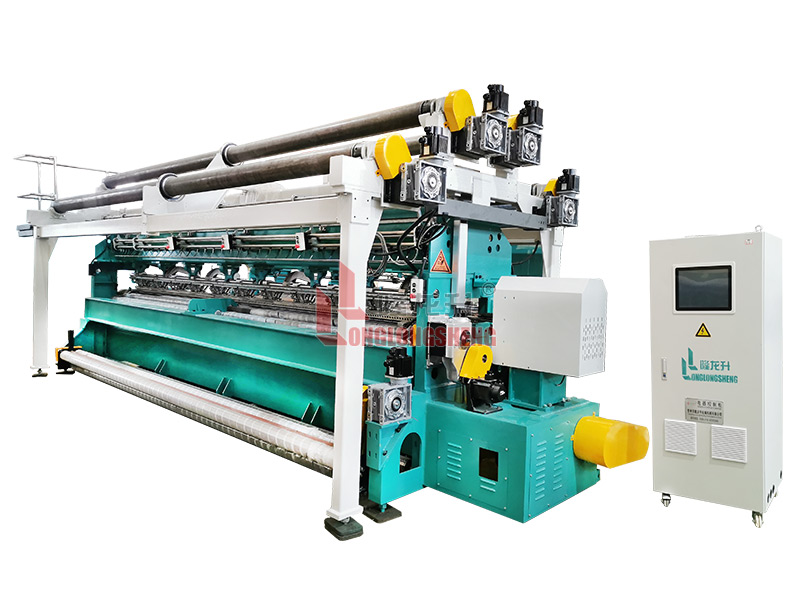
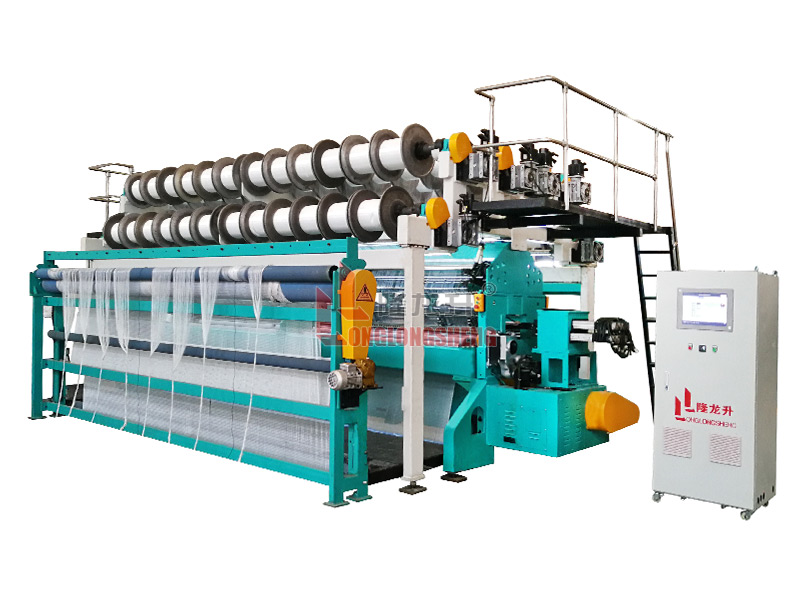
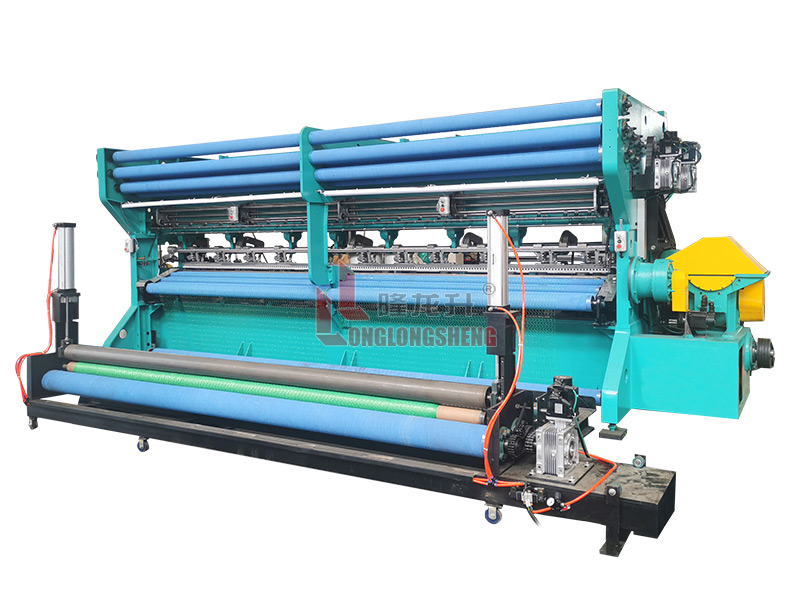
LONGLONGSHENG machine - Warp knitting machine China Suppliers
Mobile Browse


Sources: Longlongsheng | Release date: 2026-08-15 15:35:19 | View: 9230
Abstract:
Learn what a warp knitting machine is, how it works, its main components, types, applications, and how to choose the right machine.
A warp knitting machineis an industrial textile machine that produces knitted fabrics by forming interconnected loops from multiple yarns supplied in parallel along the length of the fabric. Unlike weft knitting, which generally forms loops across the width of the fabric, warp knitting uses multiple warp yarns working simultaneously with a row of knitting needles.
The basic working process is:
Warp yarn preparation → Yarn feeding → Guide bar movement → Loop formation → Fabric formation → Take-down and winding
Warp knitting machines are widely used to manufacture mesh fabrics, fishing nets, agricultural nets, safety nets, sports nets, shoe materials, spacer fabrics, lace, and other technical textiles.
The two major machine categories are Tricot and Raschel warp knitting machines. Specialized configurations, including double needle bar and Jacquard warp knitting machines, can produce more complex structures and three-dimensional fabrics.
Understanding how a warp knitting machine works is important when choosing equipment for a specific textile application because machine type, gauge, guide bar configuration, yarn, working width, and production requirements all affect the final fabric.
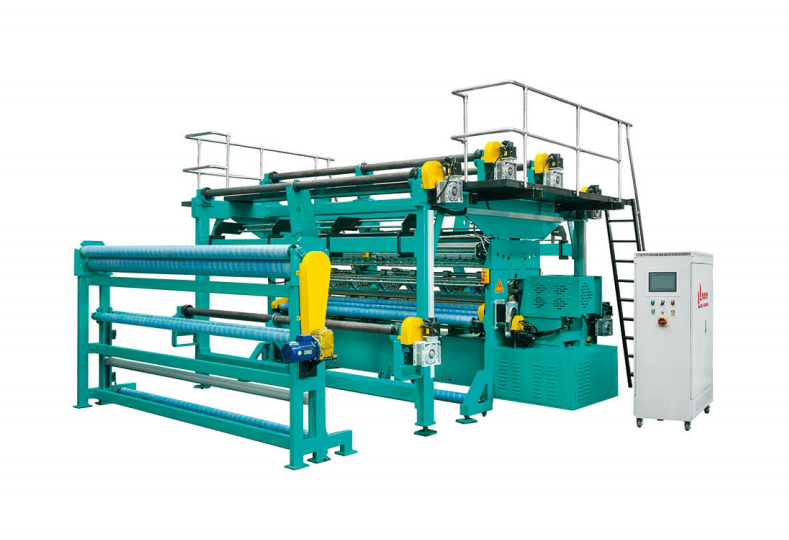
A warp knitting machine is a textile machine that forms fabric by knitting multiple warp yarns into interconnected loops.
The yarns are supplied from warp beams and arranged approximately parallel to the machine direction. Guide bars move the yarns around the knitting needles according to a predetermined lapping pattern, while the needles form new loops.
Unlike weaving, where warp and weft yarns are interlaced, warp knitting creates fabric through loop formation and interlooping.
A simplified description of the process is:
Multiple parallel yarns → Guide bar movement → Needle loop formation → Interconnected loops → Continuous fabric
Because many yarns and needles operate simultaneously, warp knitting is particularly suitable for continuous industrial production.
The final fabric structure depends on factors such as the yarn used, machine gauge, number of guide bars, lapping pattern, knitting speed, and take-down settings.
A warp knitting machine works through the coordinated movement of several systems.
The warp beam supplies yarn, the let-off system controls yarn delivery, guide bars position the yarns around the needles, needles form loops, sinkers help control the knitting process, and the take-down system continuously removes the finished fabric.
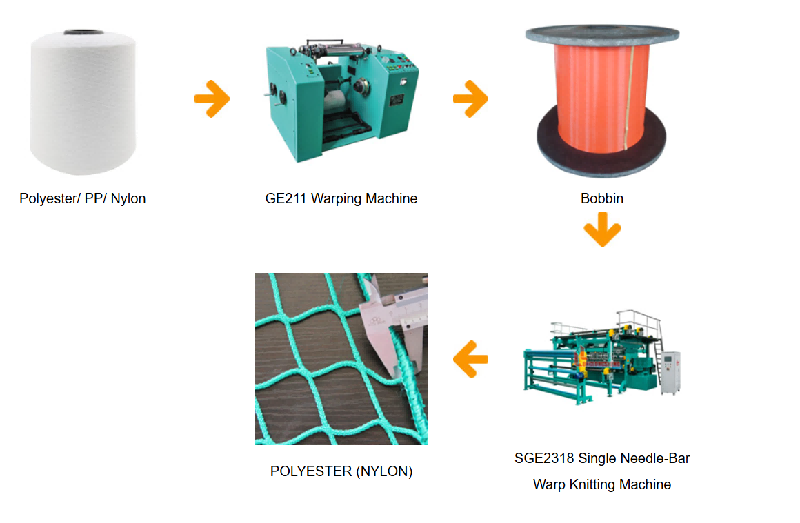
The production process begins with yarn preparation.
The selected yarn is wound onto warp beams so that it can be supplied to the machine in a controlled and organized manner.
Depending on the application, manufacturers may use different yarn materials and constructions, including synthetic filament yarns, monofilaments, multifilaments, and other specialized yarns.
Important yarn characteristics include:
· Yarn material
· Yarn count or denier
· Filament structure
· Tensile strength
· Elongation
· Abrasion resistance
· Friction characteristics
· Uniformity
Consistent yarn quality is important because variations in yarn diameter or tension can affect loop formation and fabric uniformity.
For large industrial machines, proper warping is especially important because hundreds or even thousands of yarn ends may be processed simultaneously.
After the warp beams are prepared, the yarns are supplied to the knitting area.
The let-off system controls how yarn is released from the warp beam and helps maintain stable yarn tension during production.
Stable yarn delivery is essential because the amount of yarn supplied to the knitting zone directly affects loop formation and fabric structure.
Modern warp knitting machines may use electronic or servo-controlled let-off systems to improve yarn tension control and production stability.
The objective is not simply to feed yarn at high speed. The yarn must be delivered at a controlled rate that matches the knitting process.
The guide bar is one of the key components of a warp knitting machine.
Each guide bar carries yarn guides through which the warp yarns pass. During operation, the guide bars move the yarns around the knitting needles according to a programmed lapping pattern.
Two fundamental movements are commonly used to describe this process:
Overlap refers to the movement that positions the yarn around the needle so that it can participate in loop formation.
Underlap refers to the lateral movement of the guide bar between neighboring needles. This movement connects successive loops and contributes significantly to the resulting fabric structure.
By changing the guide bar movement and lapping pattern, manufacturers can create different fabric structures, mesh geometries, patterns, and surface effects.
The knitting needles work together with the guide bars to create new loops.
During each knitting cycle, the guide bar places yarn around the appropriate needle. The needle then draws the new yarn through an existing loop to form a new loop.
This process occurs repeatedly across the machine width.
In simplified terms:
Existing loop → New yarn is supplied → Needle forms a new loop → Existing loop is cleared → New loop becomes part of the fabric
Because many needles operate simultaneously, a large number of loops can be formed during each machine cycle.
The exact needle movement depends on the machine design. Tricot and Raschel machines, for example, use different mechanical arrangements and are optimized for different fabric structures and applications.
The underlap movement is particularly important in warp knitting because it determines how loops are connected across the fabric.
After forming a loop, the guide bar moves laterally according to the programmed lapping pattern. This movement changes the position of the yarn relative to the needles before the next knitting cycle.
The lapping pattern can influence:
· Mesh geometry
· Fabric density
· Pattern
· Stretch
· Stability
· Surface appearance
· Yarn consumption
This is one of the main reasons warp knitting technology can produce such a broad range of textile structures.
Simple lapping patterns can produce relatively straightforward fabrics, while more complex guide bar arrangements and patterning systems can create decorative or technical structures.
As the machine continuously forms new loops, the finished fabric must be removed from the knitting zone.
The take-down system pulls the fabric away from the needles at a controlled rate.
The fabric is then wound into rolls or transferred to another processing stage.
Take-down speed is important because it can affect fabric density, dimensions, and overall construction.
For this reason, the major machine systems must work together:
Yarn feeding + guide bar movement + needle movement + take-down
Stable coordination between these systems is essential for consistent production.
A warp knitting machine consists of several interconnected mechanical, electronic, and yarn-handling systems.
Understanding these components makes it easier to understand how the machine operates and how different specifications influence the finished fabric.
The warp beam stores and supplies the warp yarns to the knitting area.
The let-off system controls yarn delivery and helps maintain stable yarn tension.
For high-speed production, accurate yarn let-off is important because unstable yarn tension can result in variations in the knitted structure.
Guide bars control the position and movement of the yarns.
Each guide bar contains multiple yarn guides, and the movement of these guides determines how the yarns are laid around the needles.
The number of guide bars and their configuration influence the types of structures that can be produced.
Machines designed for more complex patterns or technical fabrics may use additional guide bars or specialized patterning systems.
The needle bar holds the knitting needles across the working width of the machine.
The needles receive the yarn from the guide bars and form new loops.
Depending on the machine design, different needle technologies may be used.
The machine gauge is also an important specification because it relates to needle density and has a significant influence on the fineness of the resulting fabric structure.
Sinkers help control the fabric and existing loops during the knitting cycle.
They support the fabric while the needles move and help maintain proper loop formation.
The design and movement of the sinker system depend on the specific machine type.
The patterning system determines how guide bars and other pattern-forming elements move.
Traditional mechanical patterning systems have increasingly been complemented or replaced by electronic control technologies on modern machines.
Electronic patterning can make it easier to adjust production parameters and create different fabric designs.
The take-down system continuously removes the knitted fabric from the knitting zone.
Its speed and stability affect fabric density and dimensions.
A properly synchronized take-down system is therefore essential for maintaining consistent fabric quality.
The drive system coordinates the movement of the machine’s major mechanical components.
Modern machines may incorporate:
· Servo drives
· Inverter systems
· Electronic let-off
· Electronic take-up
· Digital control systems
· Sensors
· Production monitoring functions
The exact configuration varies according to machine type and application.
Warp knitting machines can be divided into several categories based on their structure and intended applications.
The two major machine families are Tricot and Raschel, while double needle bar and Jacquard technologies provide additional capabilities for specialized fabrics.
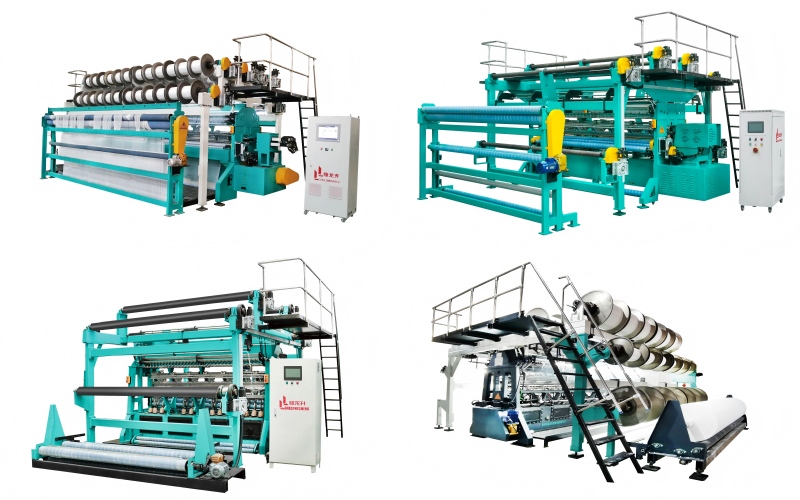
Tricot machines are generally associated with fine-gauge, smooth, and high-speed warp-knitted fabrics.
Typical applications include:
· Lingerie fabrics
· Sportswear fabrics
· Swimwear materials
· Lightweight apparel fabrics
· Linings
· Automotive textiles
· Technical fabrics
Tricot machines are commonly selected when manufacturers require fine, stable, and efficient production of relatively closely structured fabrics.
Raschel machines are widely used for open, patterned, bulky, and technical textile structures.
Typical applications include:
· Fishing nets
· Agricultural nets
· Safety nets
· Shade nets
· Sports nets
· Lace
· Curtains
· Mesh fabrics
· Technical textiles
Raschel technology is particularly important for net production because specialized machines can process appropriate yarns and create different mesh sizes and net structures.
This makes Raschel machines an important equipment category for manufacturers producing fishing nets and other industrial netting.
Internal linking opportunity:The anchor text “fishing net warp knitting machine” can naturally link here to your relevant product page.
Double needle bar machines use two needle beds to produce more complex three-dimensional structures.
They can be used to produce:
· Spacer fabrics
· 3D mesh
· Plush fabrics
· Double-sided fabrics
· Shoe materials
· Automotive textiles
· Other technical fabrics
The two needle beds allow manufacturers to create structures that are difficult or impossible to produce with a conventional single needle bed machine.
This makes double needle bar technology particularly useful for applications requiring thickness, cushioning, three-dimensional structure, or two connected fabric surfaces.
Internal linking opportunity: The anchor text “double needle bar warp knitting machine” can naturally link to your relevant product category.
Jacquard warp knitting machines add advanced patterning capabilities to the warp knitting process.
They can produce more complex visual and structural effects through controlled yarn movement or selection.
Typical applications include:
· Decorative fabrics
· Fashion textiles
· Upholstery
· Shoe materials
· Patterned mesh
· Technical textiles
When combined with appropriate guide bar configurations, Jacquard technology can significantly expand the design possibilities of warp knitting.
Tricot and Raschel machines use the same basic principle of warp knitting, but they are designed for different production requirements.
|
Feature |
Tricot Machine |
Raschel Machine |
|
Typical fabric |
Fine and smooth fabrics |
Mesh, lace, nets and technical structures |
|
Typical yarns |
Generally finer yarns |
Wider range of yarn types |
|
Typical applications |
Apparel and sportswear |
Nets, lace and technical textiles |
|
Production characteristics |
High-speed fine-gauge production |
Flexible structural production |
|
Fabric structure |
Generally finer and closer |
Often more open or complex |
|
Common products |
Lingerie, sportswear, lining |
Fishing nets, agricultural nets, safety nets |
However, this distinction should not be treated as an absolute rule.
Modern warp knitting machines have different configurations, and the actual capabilities depend on machine gauge, guide bar arrangement, yarn, patterning system, and production requirements.
The correct machine should therefore be selected based on the target product and required fabric structure, rather than simply choosing between “Tricot” and “Raschel.”
Warp knitting technology can produce a wide range of textile structures.
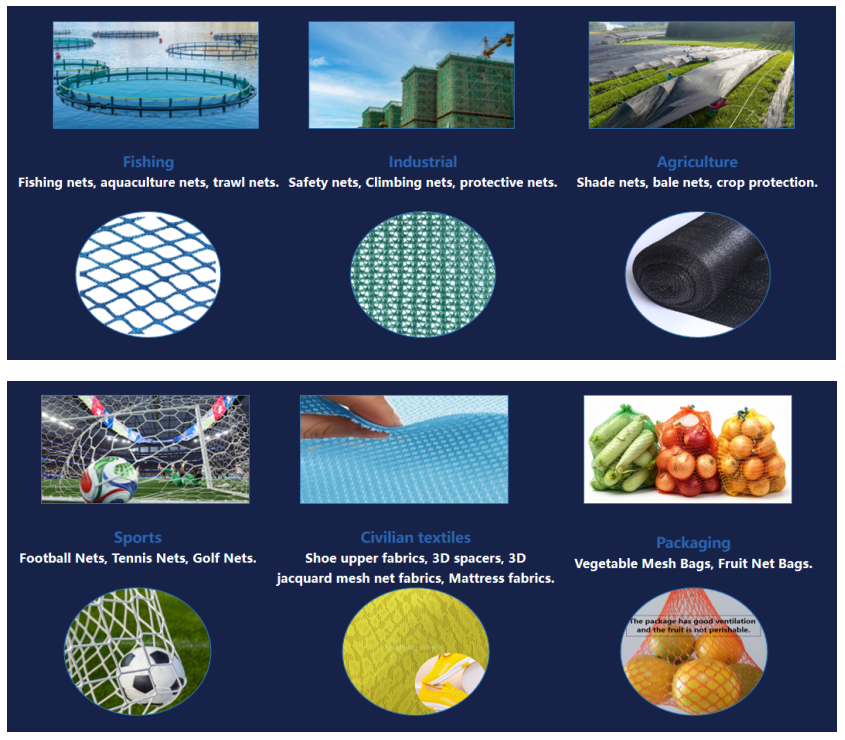
Mesh fabrics can be manufactured with different opening sizes, densities, yarns, and structural patterns.
They are commonly used in footwear, sportswear, filtration, industrial products, and technical textiles.
Dedicated Raschel warp knitting machines can produce knotless fishing nets from suitable synthetic yarns such as nylon, PE, and PP, depending on machine configuration.
For manufacturers interested in the production process itself, see our guide on how knotless fishing nets are made.
Internal linking opportunity:Link the phrase “how knotless fishing nets are made” to your related blog article.
Warp knitting machines can produce different agricultural netting products, including shade nets, crop protection nets, and other support or protective structures.
The required machine configuration depends on the mesh size, yarn, width, and final application.
Large-width Raschel machines can be configured to manufacture various safety and protective nets.
These applications generally require appropriate yarn strength, mesh dimensions, and production stability.
Warp-knitted mesh and three-dimensional fabrics are widely used in footwear because they can combine lightweight construction, breathability, flexibility, and structural support.
Double needle bar and Jacquard technologies can provide additional possibilities for three-dimensional structures and patterned shoe materials.
Double needle bar machines can produce spacer fabrics consisting of two outer surfaces connected by spacer yarns.
These structures can provide thickness, cushioning, ventilation, and three-dimensional stability.
Raschel and specialized patterning systems can produce intricate decorative structures for fashion, interior, and other applications.
Warp knitting technology is also used for automotive textiles, filtration materials, reinforcement structures, protective products, and other technical applications.
The actual range of products depends on the machine configuration and yarn specifications.
Warp knitting machines are used across both traditional textile manufacturing and technical textile production.
Major applications include:
Apparel:Lingerie, sportswear, swimwear, linings, and fashion fabrics.
Footwear:Shoe uppers, mesh materials, spacer fabrics, and structural materials.
Fishing and aquaculture:Fishing nets, aquaculture nets, and related netting products.
Agriculture:Shade nets, crop protection nets, and agricultural support nets.
Sports:Sports nets and performance fabrics.
Automotive:Interior textiles, seat materials, and technical textile structures.
Industrial applications:Filtration, protection, reinforcement, packaging, and other technical textiles.
This broad application range is one of the main advantages of warp knitting technology. By changing the machine configuration, yarn, gauge, guide bar movement, and knitting pattern, manufacturers can produce significantly different textile structures using the same fundamental knitting principle.
Warp knitting and weft knitting both use loops to create knitted fabrics, but the direction of yarn feeding and the way loops are formed are different.
|
Feature |
Warp Knitting |
Weft Knitting |
|
Yarn direction |
Mainly along the fabric length |
Mainly across the fabric width |
|
Yarn supply |
Multiple yarns work simultaneously |
Often one or a smaller number of yarn systems |
|
Loop formation |
Multiple needles operate simultaneously |
Loops are generally formed progressively across courses |
|
Production |
Highly suitable for continuous industrial production |
Also widely used for continuous production |
|
Fabric stability |
Generally stable |
Often more extensible |
|
Typical machines |
Tricot and Raschel |
Circular and flat knitting machines |
|
Typical products |
Mesh, nets, lace, technical fabrics |
T-shirts, sweaters, hosiery and other knitwear |
A key difference is that warp knitting normally uses a separate yarn end for many or most knitting positions across the machine width.
This parallel yarn arrangement allows many loops to be formed simultaneously and makes warp knitting particularly suitable for continuous industrial production.
Warp-knitted fabrics can also have different dimensional and structural behavior from weft-knitted fabrics, depending on the specific construction.
Machine performance is determined by more than the maximum advertised machine speed.
Several factors work together to determine actual production efficiency and fabric quality.
Yarn diameter, strength, elongation, friction, and consistency affect knitting stability.
A yarn that is unsuitable for the machine or fabric structure can lead to frequent yarn breaks and inconsistent production.
Stable yarn tension is essential for uniform loop formation.
Uneven tension can contribute to fabric bars, irregular loops, holes, or other defects.
Gauge affects needle density and therefore has an important influence on fabric fineness and structure.
The correct gauge should be selected according to the target fabric and yarn.
The number and arrangement of guide bars influence the available lapping patterns and fabric structures.
More complex products may require specialized guide bar configurations.
Higher machine speed can increase production output, but only when the machine can maintain stable operation at the required speed.
Actual production depends on yarn, fabric structure, machine settings, operator skill, maintenance, and production efficiency.
Stable let-off and take-down systems help maintain consistent yarn supply and fabric construction.
Electronic systems can provide more precise control in modern machines.
Needles, guide elements, sinkers, yarn guides, bearings, drive components, and other machine parts require regular inspection and maintenance.
A well-maintained machine is more likely to maintain stable production and reduce unplanned downtime.
The right warp knitting machine should be selected according to the product you plan to manufacture, rather than simply the machine’s maximum speed.
Before purchasing a machine, manufacturers should evaluate the following factors.
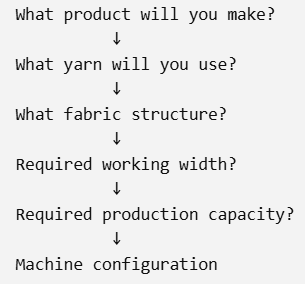
First determine the target product:
· Fishing nets
· Shade nets
· Safety nets
· Agricultural nets
· Sports nets
· Shoe materials
· 3D mesh
· Spacer fabrics
· Lace
· Apparel fabrics
· Technical textiles
The target product will determine which machine type and configuration are appropriate.
Check the machine’s compatibility with the intended yarn.
Important parameters include:
· Yarn material
· Yarn count or denier
· Monofilament or multifilament construction
· Tensile strength
· Elongation
· Friction characteristics
The yarn should be compatible with both the machine and the intended fabric structure.
Define the required:
· Mesh size
· Fabric density
· Thickness
· Stretch
· Pattern
· Surface structure
· Dimensional stability
These requirements determine the appropriate gauge, guide bar configuration, needle system, and patterning technology.
Working width should match the target product and production requirements.
A machine that is too narrow may limit production efficiency, while an unnecessarily large machine can increase investment and operating costs.
Consider both machine speed and actual output.
Theoretical machine speed does not automatically equal production capacity.
Actual output depends on:
· Machine speed
· Fabric structure
· Yarn characteristics
· Machine efficiency
· Production downtime
· Operator experience
· Maintenance condition
Modern warp knitting machines may include:
· Electronic let-off
· Electronic take-down
· Servo drives
· Digital control
· Automatic monitoring
· Production data management
The appropriate automation level depends on the product, production scale, and operating requirements.
For industrial textile machinery, technical support is an important part of the purchasing decision.
Manufacturers should consider:
· Installation
· Commissioning
· Operator training
· Spare parts
· Maintenance
· Troubleshooting
· Process optimization
· Technical assistance
A machine is not simply a standalone piece of equipment. It is the core of a complete production process.
A warp knitting machine is an industrial textile machine that forms fabric by creating interconnected loops from multiple parallel warp yarns.
Warp yarns are supplied from warp beams to guide bars. The guide bars position the yarns around the knitting needles, the needles form new loops, and the take-down system continuously removes the finished fabric.
The major types include Tricot and Raschel warp knitting machines.
Specialized configurations include double needle bar and Jacquard warp knitting machines.
Tricot machines are generally associated with fine-gauge, smooth, high-speed fabrics, while Raschel machines are widely used for mesh, nets, lace, and technical textile structures.
The exact capabilities depend on the machine configuration.
Yes. Dedicated Raschel warp knitting machines are commonly used to produce knotless fishing nets and other netting products.
Yes. Warp knitting machines can produce mesh, spacer fabrics, 3D structures, and other materials used in footwear.
Double needle bar and Jacquard configurations can provide additional structural and patterning capabilities.
A guide bar is a component that carries yarn guides and moves yarns around the knitting needles according to a predetermined lapping pattern.
Guide bar movement is one of the fundamental factors determining the structure of a warp-knitted fabric.
Machine gauge refers to the needle density of the knitting system. It has an important influence on the fineness and structure of the resulting fabric.
Warp knitting is highly suitable for continuous industrial production because multiple yarns and needles can operate simultaneously.
However, there is no single speed that applies to all warp knitting machines. Actual production speed depends on machine type, gauge, yarn, fabric structure, and machine configuration.
A warp knitting machine transforms multiple parallel yarns into a continuous knitted fabric through a precisely coordinated process of yarn feeding, guide bar movement, needle action, loop formation, and fabric take-down.
The basic working principle can be summarized as:
Parallel warp yarns → Guide bar movement → Needle loop formation → Interconnected loops → Continuous fabric
Tricot machines are generally suited to fine and closely structured fabrics, while Raschel machines provide greater flexibility for mesh, nets, lace, and many technical textile applications. Double needle bar and Jacquard technologies further expand the range of structures that can be produced.
For manufacturers, selecting the right machine should begin with the final product, yarn, fabric structure, working width, required output, and production environment.
LongLongSheng develops warp knitting machine solutions for different textile applications, including fishing nets, agricultural nets, safety nets, mesh fabrics, shoe materials, and other technical textiles.
The right machine configuration depends on the specific production requirements rather than a single machine specification. Understanding the relationship between yarn, gauge, guide bar configuration, working width, and fabric structure is therefore essential when planning a new warp knitting production line.
Explore LongLongSheng’s Warp Knitting Machine Solutions and find the machine configuration that matches your target product and production requirements.
Explore the GE2820 double needle-bar warp knitting machine for sports, safety and packaging nets, with key features, spec…
Learn how to choose a warp knitting machine for shade net production based on yarn, gauge, width, guide bars, speed, mesh…
Learn what a warp knitting machine is, how it works, its main components, types, applications, and how to choose the righ…