LONGLONGSHENG machine - Warp knitting machine China Suppliers
Mobile Browse


Sources: Longlongsheng | Release date: 2026-11-06 16:52:03 | View: 5424
Abstract:
How are knotless fishing nets manufactured? Explore the Raschel warp knitting process, materials, production steps, quality control and machinery.
Knotless fishing nets are widely used in commercial fishing, aquaculture, and other netting applications where strength, flexibility, and consistent mesh structures are important. Unlike traditional knotted nets, which connect yarns through individual knots, knotless nets are produced through specialized manufacturing processes that create interconnected mesh structures without conventional knots.
One of the most widely used industrial methods for manufacturing knotless fishing nets is Raschel warp knitting. This technology uses multiple yarn systems and a controlled knitting process to form continuous mesh fabrics with consistent structures and customizable specifications.
But how exactly are knotless fishing nets made? What materials are used, what machines are required, and which production steps determine the final net quality?
This guide explains the complete knotless fishing net manufacturing process, from yarn preparation and warping to warp knitting, quality inspection, and finished net assembly. It also explores the role of Raschel warp knitting machines in modern fishing net production.
Knotless fishing nets are netting fabrics manufactured without conventional knots at the intersections of mesh bars. Instead of tying individual yarns together, the manufacturing process uses interlooping, interlacing, or other specialized structural techniques to connect the yarn systems and form stable mesh openings.
Raschel warp-knitted netting is an important example of this construction. During knitting, yarns are arranged and interlooped according to a specific pattern to create interconnected mesh structures.
Knotless nets are used in various fishing and aquaculture applications because their smooth construction, relatively low bulk, and flexible mesh structures can offer practical advantages over conventional knotted netting.
The main difference between knotless and knotted fishing nets is how the mesh intersections are constructed.
Traditional knotted nets are manufactured by tying yarns or twines together at each mesh intersection. These knots create visible connection points and can concentrate stress when the net is under tension.
Knotless nets use alternative construction methods to connect the yarn systems without conventional tied knots. Depending on the manufacturing method, the resulting mesh can have a smoother surface and a different distribution of mechanical stress.
The main differences include:
| Comparison | Knotted Fishing Nets | Knotless Fishing Nets |
|---|---|---|
| Construction | Yarns connected by knots | Yarns connected through specialized structures |
| Surface | Visible knots at intersections | Generally smoother intersections |
| Weight | Can be bulkier due to knots | Often lighter for comparable constructions |
| Water resistance | Depends on net structure and knot geometry | Can offer reduced hydrodynamic resistance |
| Manufacturing | Knotting or net-making processes | Raschel knitting or other knotless methods |
| Applications | Commercial fishing and general netting | Fishing, aquaculture, and specialized netting |
The actual performance of either construction depends on yarn material, mesh dimensions, twine size, structural design, and manufacturing quality. Therefore, knotless construction should not automatically be considered superior for every fishing application.
Knotless netting offers several potential advantages for industrial fishing applications.
Smooth mesh intersections
The absence of conventional tied knots creates a smoother net surface. This can help reduce friction between the netting and surrounding objects during handling and operation.
Efficient use of yarn strength
Traditional knots can create localized stress concentrations and reduce the effective strength of yarns. Knotless constructions distribute loads differently, potentially improving strength utilization when properly designed.
Reduced bulk and weight
Without bulky knots, certain knotless net structures can be lighter and easier to handle than comparable knotted constructions.
Flexible mesh design
Industrial warp knitting technology allows manufacturers to adjust yarn arrangements and knitting structures to produce different mesh configurations for specific applications.
These characteristics make knotless netting an important option for modern fishing net and aquaculture net production.
The selection of raw materials is one of the most important decisions in fishing net manufacturing. Different fibers provide different levels of strength, flexibility, abrasion resistance, chemical resistance, and durability.
The appropriate material depends on the intended fishing environment, net design, operating conditions, and customer requirements.
HDPE is widely used in fishing nets, aquaculture netting, and other industrial net applications.
Its main characteristics include:
Low density and relatively lightweight construction.
Good resistance to moisture and many chemicals.
Good flexibility for various netting structures.
Suitability for outdoor applications when appropriate UV stabilization is incorporated.
HDPE is often selected for applications where lightweight construction and environmental resistance are important.
For outdoor fishing and aquaculture applications, UV stabilization and material quality should be considered carefully to improve service life under sunlight exposure.
Nylon is another commonly used material in fishing net production.
Its characteristics include:
High tensile strength.
Good flexibility and elasticity.
Good abrasion resistance.
Suitability for various commercial fishing applications.
Nylon netting is used in different fishing gear constructions, including purse seines and other fishing nets.
However, nylon can absorb moisture, which may affect its dimensions and mechanical properties. Material selection should therefore consider the operating environment and required net performance.
Polyester is valued for its dimensional stability, relatively low moisture absorption, and resistance to many environmental conditions.
Depending on the required performance, manufacturers may also consider other specialized fibers, including high-performance polyethylene yarns.
The selection of material should be based on the intended application rather than assuming that one fiber is suitable for every type of fishing net.
Important factors include yarn fineness, filament structure, tensile properties, elongation, surface characteristics, and compatibility with the selected knitting machine.
The manufacturing process of knotless fishing nets involves several interconnected stages. For Raschel warp-knitted fishing nets, the typical production process includes yarn preparation, warping, machine setup, warp knitting, fabric take-up, inspection, and subsequent finishing.
Not every factory uses exactly the same production arrangement. Some manufacturers purchase ready-made yarn and focus on net production, while others integrate additional yarn preparation or processing equipment into their production lines.
The following steps describe a typical industrial Raschel warp-knitting process.
The first step is selecting suitable yarn according to the intended net application.
Manufacturers determine the required fiber type, yarn count, filament structure, and other material properties based on the target mesh structure and expected operating conditions.
Before production, yarn packages should be checked for:
Consistent yarn thickness and quality.
Suitable tensile properties.
Stable package winding.
Surface defects or contamination.
Compatibility with the machine's yarn feeding system.
Proper yarn preparation helps reduce production interruptions and improves the consistency of the finished netting.
For factories producing HDPE fishing nets from their own raw materials, additional processes such as tape extrusion, stretching, winding, or other yarn preparation operations may be required.
After yarn preparation, the yarns are arranged and transferred onto warp beams through a warping process.
Warping is an important preparation stage because it determines how the yarns are supplied to the knitting machine.
During this process, manufacturers need to maintain:
Consistent yarn tension.
Correct yarn arrangement.
Uniform winding density.
Proper beam formation.
Stable yarn feeding conditions.
Uneven tension or poor beam preparation can lead to yarn breakage, irregular fabric structures, and inconsistent mesh dimensions during knitting.
The warping process should therefore be carefully controlled to provide a stable yarn supply for continuous production.
Raschel warp knitting is one of the key technologies used to manufacture industrial knotless fishing nets.
Unlike traditional weaving, which forms fabric by interlacing warp and weft yarns, warp knitting creates fabric through the formation and interconnection of yarn loops.
On a Raschel warp knitting machine, multiple guide bars control the movement and lapping patterns of the yarns. The needles form loops while the yarn systems interact according to the machine's knitting configuration.
For fishing net production, the knitting structure is designed to create mesh openings and connecting sections between adjacent mesh bars.
The number of guide bars, yarn arrangement, machine gauge, knitting pattern, and other configuration factors influence the resulting mesh structure.
By adjusting the appropriate machine settings and knitting structure, manufacturers can produce different types of knotless netting for specific applications.
The machine configuration must be selected according to the target yarn, mesh dimensions, net structure, and production requirements.
As the knitting process continues, the interconnected yarn loops form a continuous net fabric.
The fabric is gradually drawn away from the knitting zone by the take-up system and collected into rolls or other suitable forms.
Stable take-up tension is important because excessive or insufficient tension can influence the appearance and dimensional consistency of the finished netting.
During this stage, operators should pay attention to:
Uniform mesh openings.
Consistent mesh-bar structures.
Fabric width and dimensional stability.
Yarn feeding and take-up coordination.
Continuous machine operation.
A stable knitting and take-up process helps manufacturers maintain consistent production quality over longer operating periods.
After knitting, the netting should undergo inspection before moving to subsequent processing or final assembly.
Quality inspection helps identify structural defects and verify whether the fabric meets the required specifications.
Common inspection items include:
Mesh size and uniformity
Mesh openings should be checked against the specified dimensions. Irregular mesh sizes can affect the performance and suitability of the finished net.
Yarn and mesh-bar condition
Inspectors should check for broken yarns, missing loops, damaged sections, and other visible defects.
Tensile strength
Testing helps determine whether the netting can withstand the mechanical loads expected during use.
Dimensional consistency
Fabric width, length, and mesh dimensions should be checked to ensure that the finished material meets the production requirements.
Abrasion and environmental resistance
Depending on the application, additional tests may be required to evaluate abrasion resistance, UV resistance, and other relevant performance characteristics.
The exact testing standards and acceptance criteria should be determined according to the customer's application and applicable industry requirements.
Once the knitted netting passes inspection, it may undergo additional finishing processes.
Depending on the material and intended application, finishing operations may include:
Heat setting or dimensional stabilization.
Dyeing or coloration.
Protective coating or surface treatment.
Cutting and panel preparation.
Sewing and joining net sections.
Attachment of ropes, floats, sinkers, or other accessories.
Not every fishing net requires all these operations. The finishing process depends on the type of netting, raw material, customer specifications, and final product design.
For example, large fishing nets may require multiple net panels to be joined together before ropes and other functional components are installed.
After final inspection, the completed fishing nets can be folded, packed, and prepared for shipment.
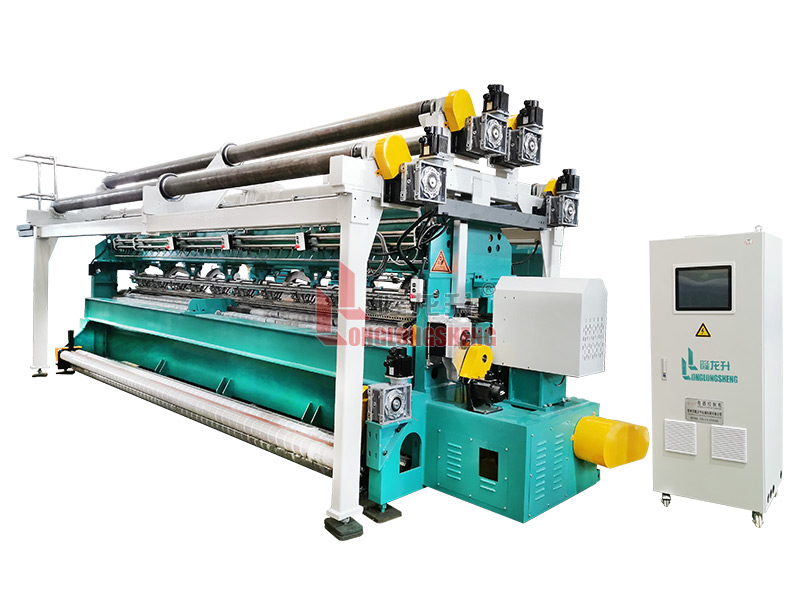
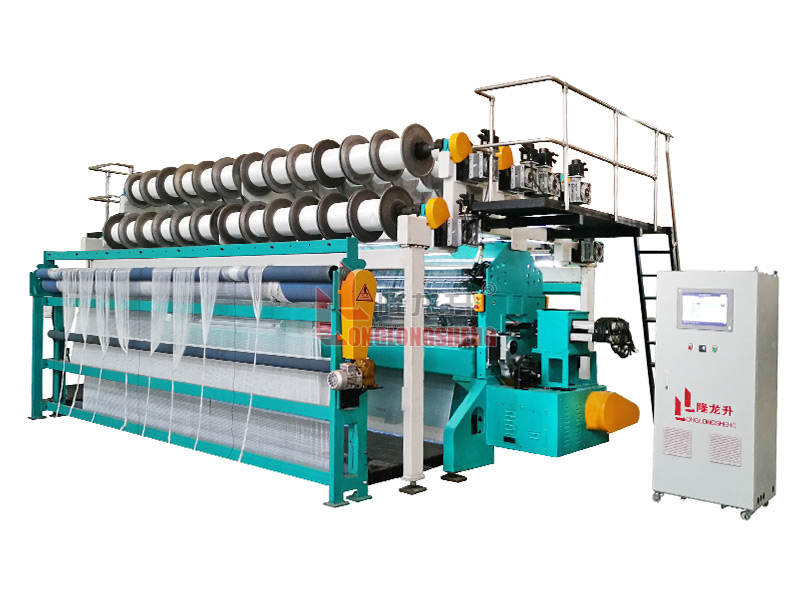
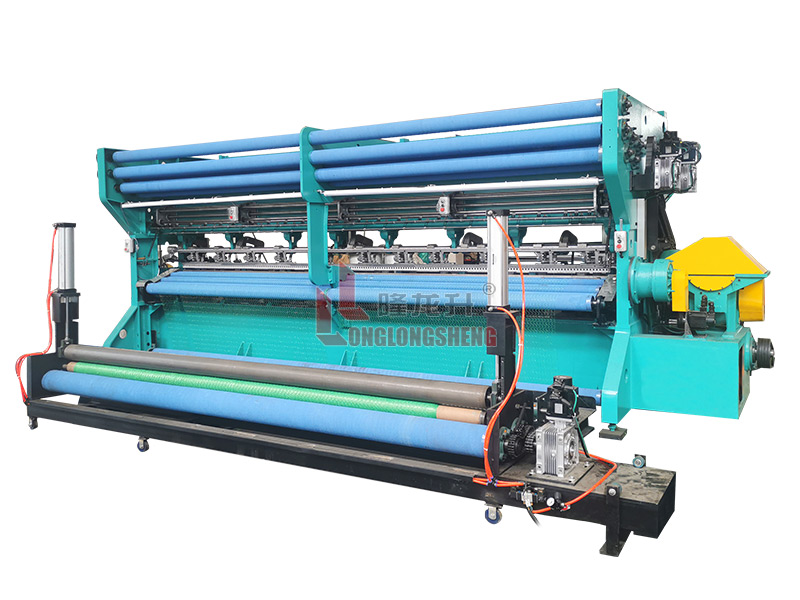
A Raschel warp knitting machine plays a central role in the industrial production of warp-knitted knotless fishing nets.
Its main function is to transform prepared yarns into interconnected mesh structures through a controlled loop-forming process.
Unlike manual knotting, which creates mesh intersections by tying individual yarns, warp knitting forms the net structure continuously through coordinated needle and guide-bar movements.
The basic knitting process involves several coordinated components.
Guide bars
Guide bars control yarn movement and determine the lapping patterns used to form the fabric structure.
Knitting needles
The needles form loops by receiving and manipulating the yarns during the knitting cycle.
Yarn feeding system
The yarn feeding system supplies the required yarns to the knitting zone under controlled conditions.
Take-up system
The take-up system draws the newly formed netting away from the knitting area and maintains the required fabric delivery conditions.
The interaction between these components allows the machine to produce continuous mesh fabrics with controlled structures.
For fishing net applications, the machine configuration and knitting pattern must be matched to the intended mesh geometry and yarn characteristics.
Choosing a suitable Raschel machine requires more than looking at its nominal operating speed.
Several factors influence the final net structure and production performance.
Machine gauge
The machine gauge determines the needle spacing and influences the range of fabric structures that can be produced. Its suitability depends on the target yarn and mesh specifications.
Number of guide bars
Guide-bar configuration affects yarn arrangement and the possible knitting structures.
Working width
Working width determines the available fabric width and should match the intended product dimensions and production requirements.
Yarn feeding stability
Stable yarn delivery helps reduce tension variations and production defects.
Take-up control
Proper take-up coordination is important for maintaining consistent fabric dimensions and mesh structures.
These factors should be evaluated together rather than considered independently when selecting equipment for knotless fishing net production.
The quality of finished knotless fishing nets is influenced by the combined performance of raw materials, machine configuration, knitting conditions, and subsequent processing.
A well-designed net structure cannot compensate for inconsistent yarn quality or poor production control.
Yarn properties directly influence the mechanical performance of the finished net.
Variations in yarn thickness, tensile strength, or surface characteristics may result in inconsistent mesh structures.
Manufacturers should select reliable raw materials and maintain consistent yarn quality throughout production.
Mesh size is one of the most important specifications in fishing net production.
Different fishing applications require different mesh dimensions and structures. The appropriate mesh size depends on the fishing method, target species, and applicable regulations.
Manufacturers should maintain stable knitting conditions to ensure that mesh openings remain consistent throughout the fabric.
Fishing nets are exposed to mechanical tension, repeated handling, and friction during operation.
The strength of the yarns, the construction of the mesh bars, and the quality of the connecting structures all contribute to the overall performance of the net.
Testing should reflect the intended operating conditions rather than relying only on the nominal properties of the raw yarn.
Fishing nets used outdoors or in marine environments may experience prolonged exposure to sunlight, moisture, saltwater, and other environmental factors.
The selection of UV-stabilized materials, appropriate coatings, and suitable finishing treatments can help improve durability where required.
Actual service life depends on material quality, net construction, maintenance, and environmental conditions.
Knotless netting can be manufactured in different structures and specifications to meet the requirements of various fishing and aquaculture applications.
Commercial fishing operations use different net designs depending on the fishing method and target species.
Knotless netting may be used in suitable fishing gear where mesh flexibility, weight, and structural performance are important considerations.
Aquaculture netting is used in fish cages, enclosures, and other fish farming facilities.
The net structure must be selected according to fish species, cage design, water conditions, mechanical loading, and maintenance requirements.
Material durability and mesh opening consistency are particularly important in these applications.
Trawl nets and purse seines are widely used commercial fishing gear.
Different sections of these nets may require different mesh sizes, yarn specifications, and structural properties.
Knotless netting can be used in suitable designs depending on the fishing method and the required performance characteristics.
Beyond conventional fishing, related warp-knitted mesh structures can also be used in certain industrial and protective netting applications.
The suitability of a particular machine and net structure should always be verified through product specifications and sample production.
For manufacturers planning to establish or expand a knotless fishing net production facility, selecting the right machinery is an important investment decision.
A suitable machine should meet the required product specifications while providing stable operation and compatibility with the planned production process.
Before choosing a machine, manufacturers should define the target product requirements.
Important specifications include:
Raw material type.
Yarn count and thickness.
Mesh size and mesh geometry.
Net width and length.
Required net structure.
Expected production output.
These specifications help determine the appropriate machine configuration.
Different fishing net products may require different machine configurations.
Working width, gauge, guide-bar arrangement, yarn feeding conditions, take-up system, and operating speed should all be considered.
Production capacity should be evaluated under realistic operating conditions, taking into account the actual yarn, knitting pattern, machine settings, and product specifications.
It is also important to confirm whether the selected equipment can meet the manufacturer's current and future product requirements.
A fishing net manufacturing facility may require more than a warp knitting machine.
Depending on the production model, supporting equipment may include:
Yarn preparation equipment.
Warping machines.
Warp knitting machines.
Fabric inspection equipment.
Finishing and treatment equipment.
Cutting and net assembly equipment.
Manufacturers should evaluate the complete production workflow to ensure that each stage can work together efficiently.
For businesses planning to manufacture HDPE fishing nets from raw materials, additional yarn production and preparation equipment may also be necessary.
LongLongSheng provides warp knitting machinery and related equipment for different industrial netting applications. Machine configuration and production arrangements can be evaluated according to the required yarn, mesh structure, working width, and intended product.
Learn more about our fishing net warp knitting machines and fishing net production solution.
No. Knotless fishing nets can be manufactured using different technologies, including Raschel warp knitting, specialized twisting or interlacing methods, and other industrial processes.
Raschel warp knitting is an important method for producing continuous knotless mesh fabrics, but it is not the only manufacturing technology available.
Knotless nets can make more efficient use of yarn strength because they avoid conventional knots that may create localized stress concentrations.
However, the actual strength depends on yarn material, mesh construction, joint structure, and manufacturing quality. A direct comparison requires testing under equivalent conditions.
There is no single best yarn for every application.
HDPE, nylon, and polyester are commonly used materials, each offering different mechanical and environmental properties.
The most suitable material depends on the intended fishing method, operating environment, required strength, and target net specifications.
Depending on its configuration and technical capabilities, a warp knitting machine may be able to produce different mesh structures and sizes through changes in knitting patterns, yarn arrangements, and machine settings.
However, not every mesh specification can be produced on every machine. Manufacturers should confirm the required product range with the equipment supplier and conduct sample trials when necessary.
Traditional knotted net making connects yarns by tying knots at mesh intersections.
Raschel warp knitting forms mesh fabrics through a continuous loop-forming process using knitting needles and guide bars.
The two methods differ in their construction principles, production processes, and the types of net structures they can produce.
Knotless fishing net manufacturing involves several interconnected stages, beginning with raw material selection and yarn preparation and continuing through warping, Raschel warp knitting, inspection, finishing, and final net assembly.
Among the available manufacturing technologies, Raschel warp knitting provides an important industrial solution for producing continuous knotless mesh fabrics with controlled structures and customizable specifications.
For fishing net manufacturers, successful production depends on selecting suitable yarn materials, matching machine configurations to product requirements, maintaining stable knitting conditions, and implementing consistent quality control throughout the process.
As an experienced warp knitting machinery manufacturer, LongLongSheng provides equipment and production solutions for fishing net and other industrial net applications. By understanding the intended product, raw materials, mesh specifications, and production requirements, manufacturers can develop a more suitable equipment configuration for their operations.
If you are planning to establish or upgrade a fishing net production line, contact LongLongSheng to discuss your product specifications and machinery requirements.
Next: None
How are knotless fishing nets manufactured? Explore the Raschel warp knitting process, materials, production steps, qual…
Learn how LongLongShengs GE2820 warp knitting machine is being evaluated for drone interception net production, including…
Explore the GE2820 double needle-bar warp knitting machine for sports, safety and packaging nets, with key features, spec…