LONGLONGSHENG machine - Warp knitting machine China Suppliers
Mobile Browse


Sources: Longlongsheng | Release date: 2026-10-20 16:49:07 | View: 6462
Abstract:
Learn how LongLongSheng's GE2820 warp knitting machine is being evaluated for drone interception net production, including mesh structure, yarn selection and production considerations.
Drone interception nets are a specialized application of technical netting, with product requirements that can differ from those of conventional sports, safety, and packaging nets. For manufacturers exploring this market, selecting suitable knitting equipment requires careful consideration of mesh structure, yarn properties, net strength, flexibility, and the intended operating environment.
LongLongSheng has conducted trial knitting of net material related to drone interception applications using its GE2820 Double Needle-bar Warp Knitting Machine. This work provides a practical starting point for evaluating the machine's potential in this emerging application area.
Rather than assuming that one machine configuration is suitable for every type of interception net, manufacturers need to assess the target product and verify its requirements through material testing and production trials. This article explains the key considerations when evaluating the GE2820 for drone interception net production and how machine configuration relates to the finished net.
Drone interception nets are net-based materials intended for applications involving the capture, restraint, or containment of unmanned aerial vehicles (UAVs). Their construction and performance requirements depend on the intended system and operating environment.
Unlike conventional nets used primarily for separating spaces, packaging products, or providing general protection, interception nets may need to meet more specialized requirements. Depending on the application, these can include controlled mesh openings, suitable yarn properties, adequate tensile strength, flexibility, and resistance to the loads imposed during use.
Not all drone interception nets share the same specifications. A net designed for one deployment method may require a different construction from a net intended for another. Therefore, the target application should be defined before selecting the yarn, mesh structure, and knitting configuration.
For net manufacturers, this creates a need to evaluate both the production process and the performance of the finished material.
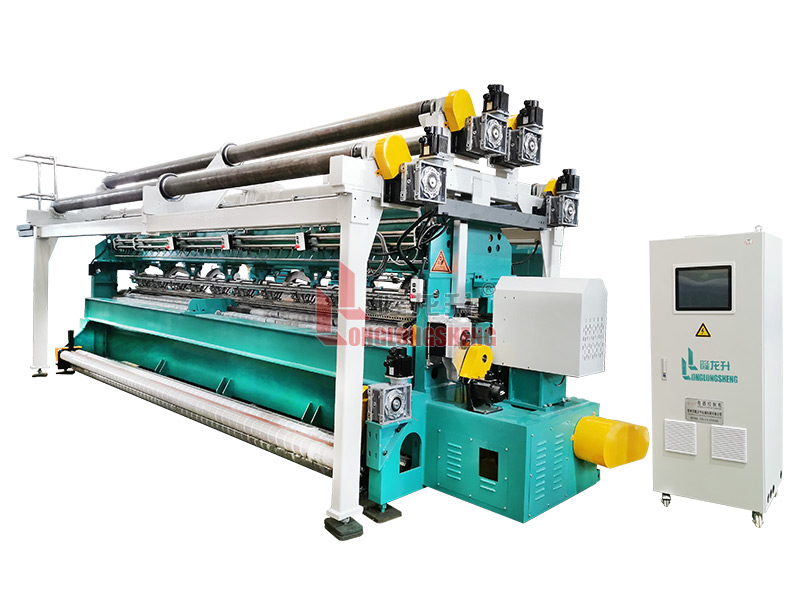
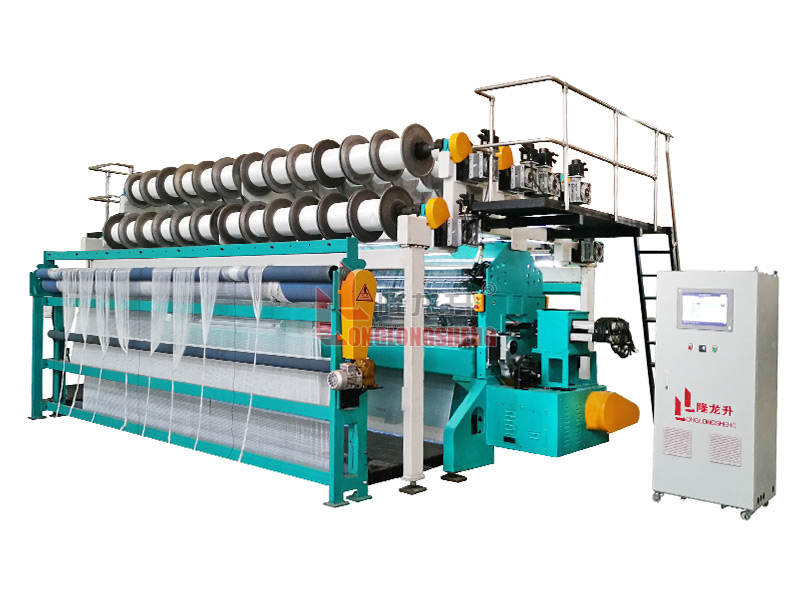
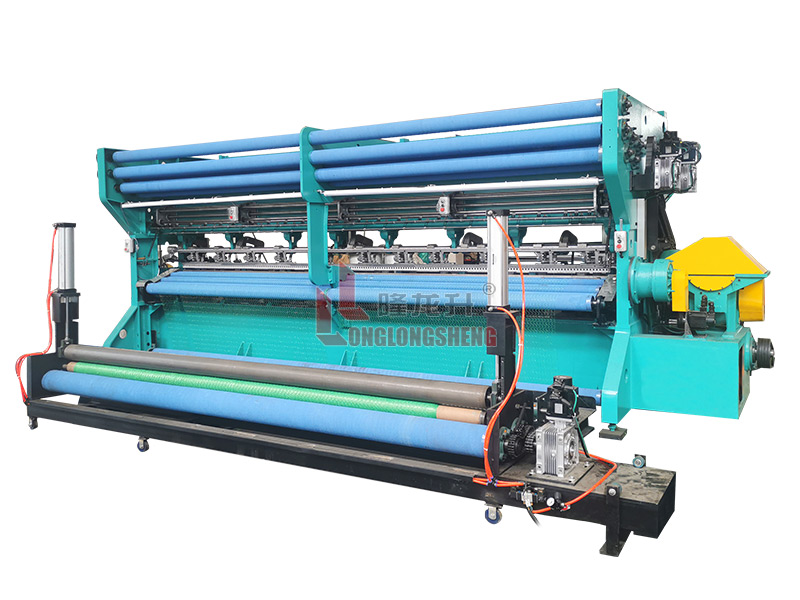
The GE2820 is a Double Needle-bar Warp Knitting Machine from LongLongSheng, designed for net production applications that include sports nets, safety nets, packaging nets, and related technical net products.
LongLongSheng has already used the GE2820 to trial-knit net material related to drone interception applications. This provides an initial basis for investigating the machine's suitability for this type of technical netting.
However, the suitability of a particular GE2820 configuration depends on the required net construction, yarn specifications, mesh opening, finished width, and performance criteria. Trial knitting is an important step in evaluating these factors, but it does not by itself establish that the finished net meets every requirement of a specific interception system.
When assessing the GE2820 for a new net application, manufacturers should consider the following factors:
·
Mesh structure:The required mesh opening, pattern, and overall construction must be compatible with the selected knitting configuration.
·
·
Yarn specifications:Yarn material, linear density, strength, elongation, and handling characteristics can affect knitting behavior and finished-net properties.
·
·
Machine configuration:Gauge, guide-bar arrangement, working width, and knitting settings should be evaluated against the target product.
·
·
Production consistency:Trial results should be assessed for mesh uniformity, dimensional stability, edge quality, and other relevant quality criteria.
·
·
Finished-product testing:The net must be tested against the technical requirements of its intended use before specific performance claims can be made.
·
This product-focused approach allows manufacturers to assess the GE2820 based on actual requirements rather than assuming that a standard configuration will suit every type of technical net.
The finished material, rather than the machine model alone, determines whether a net is suitable for its intended application. Several technical factors should therefore be considered during product development.
Mesh opening influences the physical structure of a net and may affect how it interacts with the intended object or system. The required opening size and shape depend on the specific application.
For a new net product, manufacturers should establish the target mesh dimensions and acceptable tolerances before finalizing the knitting pattern. The trial material can then be measured to determine whether the resulting structure meets the intended specification.
Machine gauge alone does not determine the finished mesh opening. Yarn size, knitting pattern, machine settings, and the overall construction also influence the result.
Yarn selection is an important part of technical net development. Different yarn materials and specifications can produce different combinations of strength, flexibility, elongation, weight, and durability.
The appropriate yarn depends on the intended operating conditions and the performance requirements of the finished net. Before production settings are finalized, manufacturers should confirm the yarn specification and evaluate its compatibility with the machine.
Where strength or durability is critical, material properties should be verified through appropriate testing rather than inferred from the yarn type alone.
Technical nets may need to balance strength with flexibility and manageable weight. These properties depend on the combined effects of yarn characteristics, knitted structure, and production conditions.
Relevant evaluations may include tensile strength, elongation, dimensional stability, mesh uniformity, and resistance to damage under the loads specified for the intended application.
The appropriate tests and acceptance criteria should be established by the product developer or end user. A knitting machine's specifications alone cannot demonstrate the mechanical performance of the finished net.
The required net width and final roll dimensions should also be defined during production planning. The GE2820 is available in nominal working-width options of 170 inches (4,318 mm) and 210 inches (5,334 mm).
These options provide a starting point for evaluating width requirements. Actual suitability should be confirmed against the intended finished dimensions, usable production width, edge treatment, and downstream processing needs.
For products with specific dimensional tolerances, the trial material should be measured after knitting and any relevant finishing process.
The GE2820 offers several machine configuration options. The appropriate combination should be selected according to the intended net structure and verified during product trials.
The listed gauge options for the GE2820 are E2, E6, E9, and E12. Gauge relates to needle spacing and influences the range of structures that can be produced.
It should not be treated as a direct measurement of the finished mesh opening. The yarn specification, pattern, and knitting settings must also be considered when evaluating a target net.
The GE2820 supports 6–8 guide bars. Guide-bar arrangement influences yarn movement and the formation of the knitted structure.
The appropriate arrangement depends on the required net construction and knitting pattern. For a new application, the proposed configuration should be checked against a sample or technical specification rather than selected solely by the number of guide bars.
The machine's listed features include an open cam system, EBA warp let-off, an EL pattern device, and a separate fabric batching system.
These are components of the machine's knitting, yarn-control, patterning, and fabric-handling arrangements. Their suitability for a specific net should be evaluated as part of the complete production setup, including yarn preparation, machine settings, operating conditions, and downstream handling.
The final configuration should be confirmed with the manufacturer before a production plan is finalized.
For a new technical net application, a structured trial process helps manufacturers identify potential issues before committing to a final production specification.
Clarify how the finished net will be used and identify the product requirements supplied by the end user or system developer. These may include mesh dimensions, finished width, yarn properties, mechanical performance, weight, and environmental conditions.
If these requirements are not yet available, they should be treated as open items rather than assumed values.
Review the yarn specification alongside the target net structure. The machine gauge, guide-bar arrangement, working width, and knitting settings should then be assessed against the proposed product.
The purpose of this step is to identify a suitable trial configuration, not to assume that one setup will work for every net design.
Produce a sample using the proposed configuration and record the relevant production settings. Examine the material for mesh uniformity, dimensions, edge quality, and visible defects.
Where possible, the trial should use the intended yarn and a representative production setup. Changes to yarn or knitting parameters should be documented so that their effects can be compared.
Assess the sample against the defined acceptance criteria. Depending on the application, testing may include mesh measurement, tensile properties, elongation, dimensional stability, and other relevant mechanical or environmental tests.
If the net is intended for a specialized interception system, its performance must also be validated under the conditions specified for that system. Successful knitting alone does not demonstrate operational interception performance.
Once the sample meets the agreed requirements, evaluate whether the knitting process can reproduce the same material consistently. This may involve additional trial runs, inspection of multiple samples, and review of yarn supply, machine settings, operator procedures, and material handling.
Only after these evaluations should the manufacturer establish production parameters and make claims about the finished product.
The following table summarizes the published GE2820 machine specifications relevant to initial equipment evaluation.
|
Technical Item |
Specification |
|
Machine type |
Double Needle-bar Warp Knitting Machine |
|
Established application groups |
Sports nets, safety nets, packaging nets |
|
Needle type |
Latch needle |
|
Available gauges |
E2, E6, E9, E12 |
|
Number of guide bars |
6–8 |
|
Nominal working widths |
170 in (4,318 mm), 210 in (5,334 mm) |
|
Knitting element drive |
Open Cam System |
|
Warp let-off / control |
EBA |
|
Pattern device |
EL |
|
Fabric batching |
Separate batching system |
These are machine specifications, not guaranteed finished-net performance values. The suitability of a specific configuration for drone interception net material must be confirmed against the target product requirements and trial results.
LongLongSheng has conducted trial knitting of net material related to drone interception applications using the GE2820. The appropriate production configuration and finished-product performance depend on the target specifications and further validation.
Not necessarily. Different products may require different mesh structures, yarn properties, mechanical performance, and dimensions. Suitability must be evaluated for the specific net design.
There is no single yarn specification that can be recommended for every application. The choice depends on the intended use, required strength, flexibility, elongation, durability, and compatibility with the selected knitting configuration.
The appropriate gauge cannot be determined from the application name alone. The target mesh structure, yarn specification, knitting pattern, and trial results should guide the selection.
No. A knitting trial demonstrates that a sample can be produced under the tested conditions. It does not establish the net's operational interception performance. That requires appropriate testing against the intended system's requirements.
Start by defining the intended net structure, yarn, finished dimensions, and required performance. Then assess the machine configuration, conduct trial knitting, inspect the sample, and carry out the necessary material and application-specific tests.
The GE2820 Double Needle-bar Warp Knitting Machine is an existing LongLongSheng net-production model that has been used in trial knitting of net material related to drone interception applications. This experience provides a starting point for evaluating its potential use in a specialized technical-net market.
The next step is to define the target product more precisely, including yarn specifications, mesh structure, finished dimensions, and required mechanical properties. Machine configuration and trial results should then be assessed against these requirements.
For manufacturers exploring this application, the most reliable approach is to work from the finished net specification back to the knitting process. This helps establish a realistic production plan while distinguishing demonstrated machine capabilities from performance requirements that still need to be verified.
Next: None
Learn how LongLongShengs GE2820 warp knitting machine is being evaluated for drone interception net production, including…
Explore the GE2820 double needle-bar warp knitting machine for sports, safety and packaging nets, with key features, spec…
Learn how to choose a warp knitting machine for shade net production based on yarn, gauge, width, guide bars, speed, mesh…