LONGLONGSHENG machine - Warp knitting machine China Suppliers
Mobile Browse


Sources: Longlongsheng | Release date: 2026-09-29 16:55:35 | View: 6921
Abstract:
Explore the GE2820 double needle-bar warp knitting machine for sports, safety and packaging nets, with key features, specifications, applications and selection guidance.
LongLongSheng's GE2820 Double Needle-bar Warp Knitting Machine is designed for manufacturers producing sports nets, safety nets, packaging nets, and other technical net products. Its double needle-bar construction, latch needles, 6–8 guide bars, open cam system, EBA, EL pattern device, and separate fabric batching system provide a machine platform for different net structures and production requirements.
The machine is available in nominal working widths of 170 inches (4318 mm) and 210 inches (5334 mm). Gauge options are E2, E6, E9, and E12, with latch needles and beam sizes of 21 × 21 inches or 30 × 21 inches. The selected configuration should be matched to the target net, yarn, mesh opening, width, and production plan rather than treated as a one-size-fits-all solution.
For a manufacturer evaluating a double needle-bar warp knitting machine, the key question is not simply how fast the machine can run. The more important question is whether the machine structure, knitting elements, guide-bar configuration, width, batching method, and control system can consistently produce the required net.
This guide explains the GE2820 from that practical perspective: what the machine is, how the knitting process works, which net applications it targets, how to select the appropriate configuration, and what to evaluate before investing in a new net production machine.
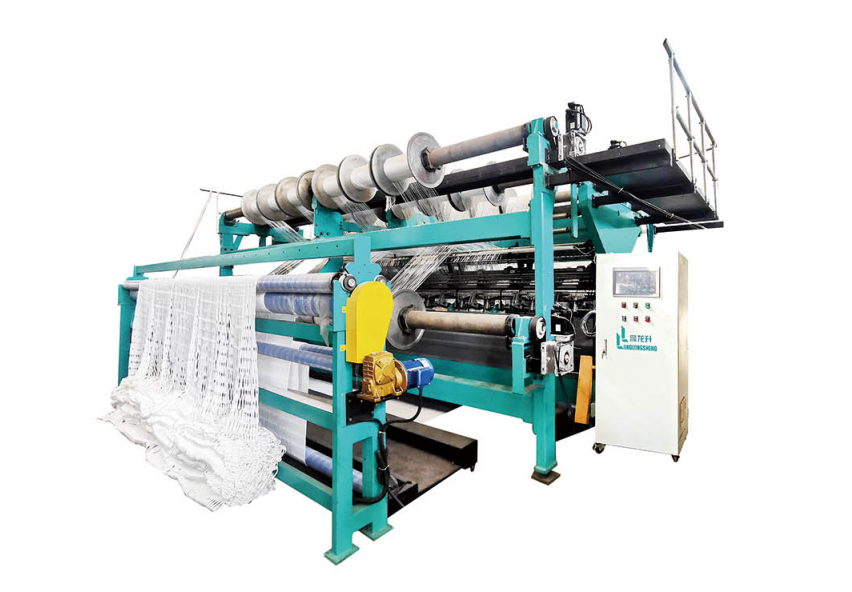
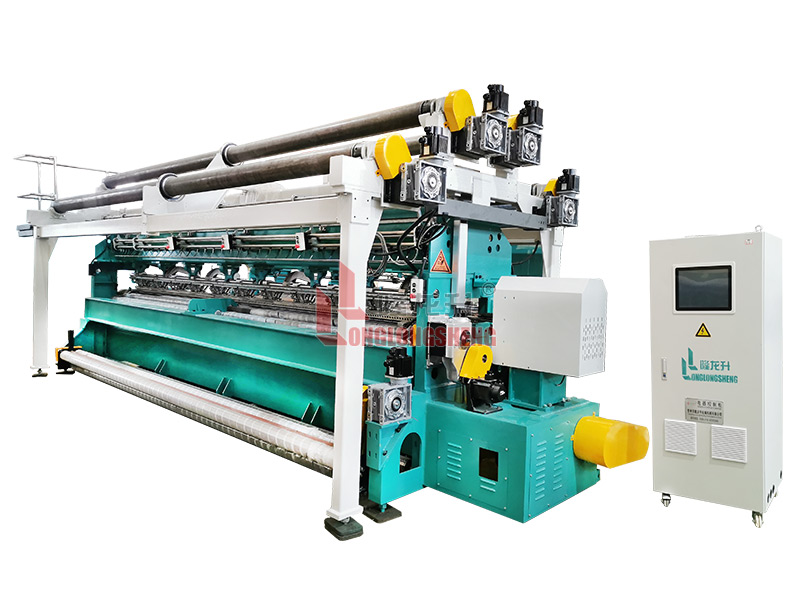
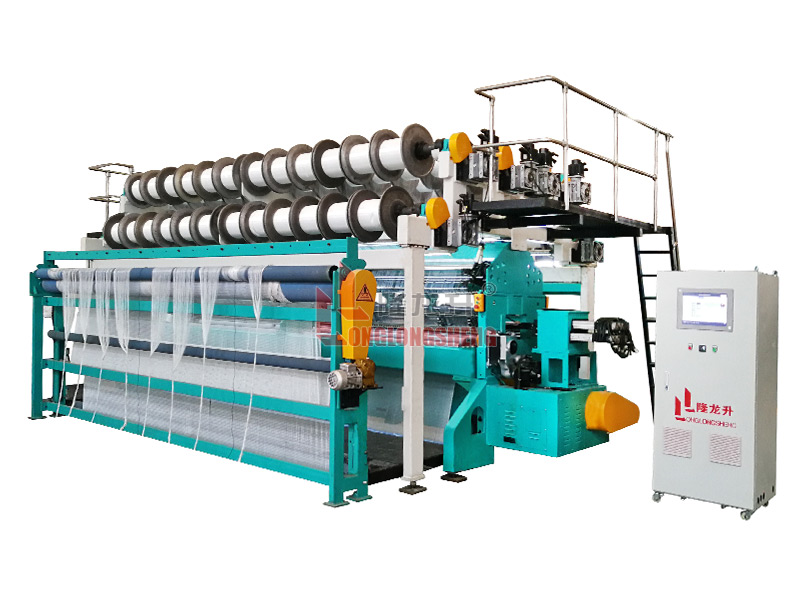
The GE2820 is a double needle-bar Raschel-type warp knitting machine intended for net production. Its configuration is centered on three major application groups: sports nets, safety and protective nets, and packaging nets.
|
Item |
GE2820 Specification |
|
Machine Type |
Double Needle-bar Warp Knitting Machine |
|
Main Applications |
Sports Nets, Safety Nets, Packaging Nets |
|
Working Needles |
Latch Needle |
|
Machine Gauge |
E2, E6, E9, E12 |
|
Number of Guide Bars |
6–8 |
|
Nominal Working Width |
170" (4318 mm), 210" (5334 mm) |
|
Beam Size |
21" × 21", 30" × 21" |
|
Knitting Element Drive |
Open Cam System |
|
Pattern Device |
EL |
|
Warp Let-off / Control |
EBA |
|
Fabric Batching |
Separate net fall-down / separate batching system |
These specifications describe the standard machine configuration. Actual production results depend on the selected gauge, yarn, mesh structure, working width, knitting parameters, and operating conditions.
A double needle-bar warp knitting machine uses two needle beds to form knitted structures from multiple warp yarns. During knitting, guide bars position the yarns relative to the needles, the needles form loops, and the coordinated movement of the knitting elements creates a continuous fabric or net structure.
For net manufacturers, the importance of the double needle-bar configuration is not simply the number of needle beds. The additional knitting elements create more possibilities for controlling how yarns are positioned and connected during loop formation. This makes double needle-bar Raschel technology suitable for specialized net constructions as well as other three-dimensional or double-sided knitted structures.
This model is specifically configured for net production rather than general apparel fabric production. Its application focus is therefore closely related to sports nets, safety nets, protective nets, packaging nets, and similar technical net products.
A single needle-bar machine forms loops using one needle bed, while a double needle-bar machine coordinates two needle beds. The choice between them should be based on the finished product rather than on the assumption that one structure is universally better.
For buyers, the practical questions are:
· What mesh structure does the finished net require?
· Does the product require a construction that benefits from two needle beds?
· What yarn and yarn thickness will be used?
· What mesh opening and finished width are required?
· What production volume and product range are planned?
This product-first approach is also useful when comparing different machine models from different manufacturers. Similar-looking machines can have different guide-bar arrangements, gauges, working widths, control systems, and take-up configurations.
The production process can be summarized as:
Warp yarn preparation → Yarn supply → Guide-bar movement → Needle action → Loop formation → Net structure formation → Fabric batching
Each stage contributes to the final mesh quality. A stable machine alone cannot compensate for an unsuitable yarn, incorrect mesh parameters, or an inappropriate machine configuration.
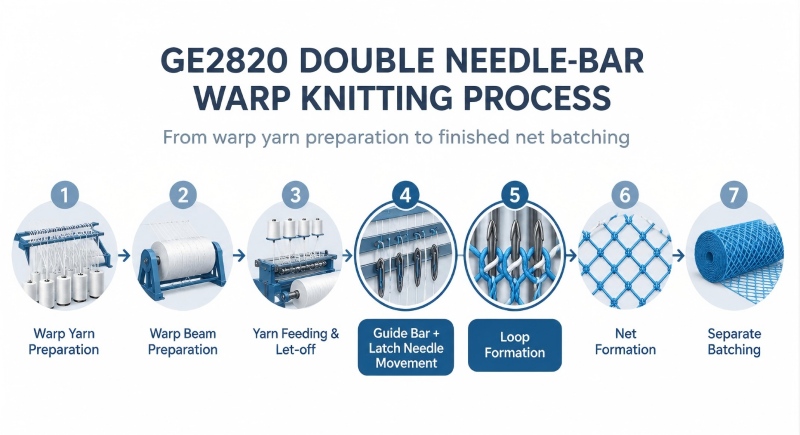
Warp knitting begins with yarns prepared for controlled delivery to the knitting elements. The yarn arrangement and preparation method must be compatible with the selected machine configuration and target product.
Before production, the manufacturer should confirm yarn material, yarn specification, beam arrangement, required tension, and the intended mesh structure. These factors influence how the machine should be configured and operated.
The machine is equipped with an EBA system for warp let-off/control. Stable yarn delivery is important because changes in yarn tension can influence loop formation and the uniformity of the finished net.
For this reason, machine selection should be considered together with the yarn preparation process. The machine, beam, yarn specification, and production settings form one system rather than independent components.
It supports 6–8 guide bars. Guide bars determine how the yarns are positioned relative to the needles and how the yarns move according to the selected pattern.
The number of guide bars is therefore a configuration parameter, not simply a numerical indicator of machine performance. The appropriate arrangement depends on the target net construction and the required yarn movement.
Latch needles are used. During knitting, the needles and guide bars work in a coordinated sequence to form and interconnect loops.
For a net manufacturer, consistent loop formation is important because variations in the knitting process can affect mesh opening, appearance, edge quality, and the overall uniformity of the finished roll.
An open cam system drives the knitting elements. The cam mechanism is part of the machine's mechanical knitting structure and coordinates the required movement of the knitting components.
When evaluating a machine, the cam system should be considered together with maintenance access, machine operation, knitting stability, and the specific production requirements of the net.
An EL pattern device is used to control guide-bar movement according to the selected knitting construction.
For net production, pattern control is closely related to the desired mesh structure. The final pattern setting should therefore be developed from the product specification and verified through production trials.
After the net is knitted, the finished material is continuously removed from the knitting area and collected by the separate batching system.
Stable batching helps maintain controlled fabric handling during continuous production. The batching method should be evaluated together with roll size, finished width, production speed, and downstream inspection or packaging requirements.
The machine is specified for sports nets, safety nets, and packaging nets. The final product range depends on the selected configuration, yarn, mesh structure, and production parameters.
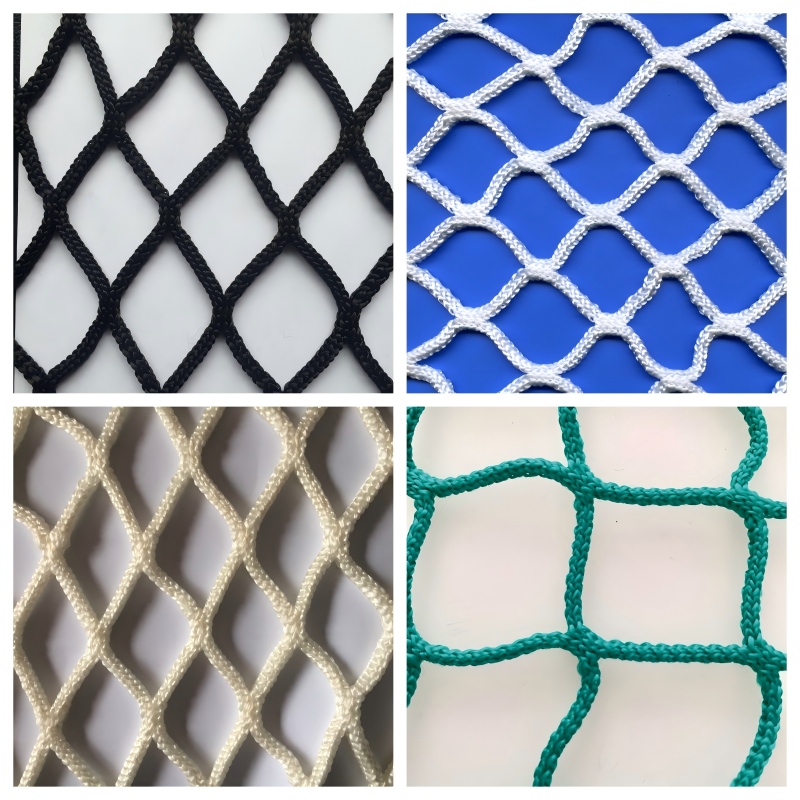
Sports nets are an important application of double needle-bar net-making technology. Depending on the finished specification, products may include:
· Football goal nets
· Tennis nets
· Volleyball nets
· Training and practice nets
· Ball-stop nets
· Sports-field barrier nets
· Protective nets for sports facilities
Sports net manufacturers generally need controlled mesh openings, consistent structure, adequate strength, and stable roll quality. The target product should be defined first, because a goal net, barrier net, and training net may have different mesh and strength requirements.
The GE2820 can also be used for safety and protective net applications. Depending on the market and finished specification, these may include construction-related protective nets, industrial protective mesh, barrier nets, and other safety-related net products.
Safety net production requires particular attention to the finished product specification. Mesh size, yarn characteristics, net construction, strength requirements, width, and applicable standards should be confirmed before selecting the final machine configuration.
Manufacturers should also distinguish between producing a net on a machine and certifying the finished safety product for a particular use. Machine capability does not by itself establish compliance with a specific safety standard; the finished product must be tested and certified according to the applicable market requirements.
Packaging nets are another core application stated for the GE2820. Open mesh packaging structures can be used for product protection, bundling, handling, and other packaging functions.
Depending on the product, packaging-net manufacturers may need to control:
· Mesh opening and shape
· Finished width
· Yarn specification
· Net strength
· Roll length
· Edge formation
· Surface appearance
Packaging applications can vary significantly. A net for agricultural produce packaging may have different requirements from a protective mesh used around industrial products. The production specification should therefore be confirmed before final machine configuration.
Double needle-bar technology is useful when the target product requires a knitted structure that is better matched to two needle beds and the associated knitting elements. The technology is used across different net and technical-textile applications, but the exact result depends on machine design and pattern configuration.
A common mistake when comparing machines is to focus on maximum rpm before defining the product. Machine speed is only one parameter. A machine running at a higher nominal speed is not automatically the more suitable machine for a particular net.
Actual production speed is affected by yarn, gauge, mesh structure, knitting pattern, machine width, machine settings, and operating conditions. For a buyer, the relevant question is the stable production speed that can be achieved for the specific product.
Uniform mesh is influenced by more than the knitting head. Yarn preparation, yarn tension, let-off, guide-bar movement, needle condition, machine adjustment, batching, and operator settings all contribute to the final result.
This is why a machine trial using the customer's actual yarn and target mesh specification can provide more useful information than comparing specification sheets alone.
It is offered in 170-inch and 210-inch nominal widths. A wider machine can be useful when the target product requires a wider finished net or when production planning benefits from greater usable width.
However, the largest available width is not automatically the correct choice. Buyers should consider finished width, edge trimming, product range, floor space, downstream handling, and expected order volume.
Available configurations include E2, E6, E9, and E12 gauges and 6–8 guide bars. These parameters should be evaluated together with yarn specification and mesh design.
The appropriate configuration is determined by the product. It is therefore better to start from the target net sample and work backward to the machine configuration than to select a gauge first and then try to adapt the product to it.
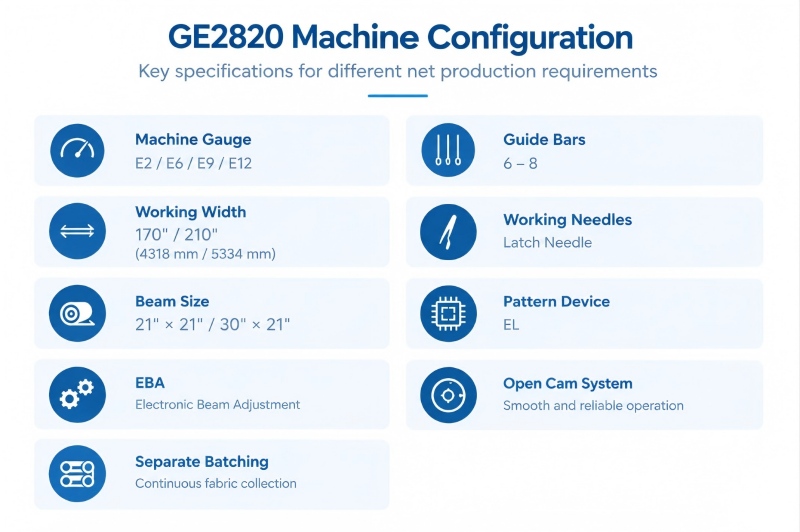
Machine gauge describes the needle density or needle spacing of the knitting system. Different gauges can be associated with different yarn and fabric structures.
For this model, the available gauge range gives manufacturers configuration options for different net requirements. The final selection should be based on the target yarn, mesh opening, net construction, and product specifications.
It supports 6–8 guide bars. Guide bars control yarn movement and contribute to the formation of the selected knitting pattern.
When comparing machines, buyers should ask the supplier which guide-bar configuration is recommended for the exact net sample they intend to produce.
The two nominal working-width options are:
· 170 inches (4318 mm)
· 210 inches (5334 mm)
Working width should be selected according to the required finished product width and production plan. A sample or technical drawing can help the supplier determine the appropriate machine width.
The listed beam sizes are 21 × 21 inches and 30 × 21 inches. Beam selection should be considered together with yarn preparation, required yarn capacity, machine configuration, and the production process.
The configuration uses an EL pattern device and EBA system. These control-related components should be evaluated as part of the overall knitting system, particularly when the manufacturer expects to produce different net structures or change product specifications over time.
A practical selection process can reduce the risk of buying a machine that is technically capable but poorly matched to the intended product.
Start with the final net, not the machine.
· What is the application?
· What mesh opening is required?
· What finished width is required?
· What net strength is required?
· What roll length or roll diameter is expected?
· What quality or market standards apply?
Confirm the yarn material, yarn form, yarn specification, and required mechanical properties. Yarn selection can affect machine gauge, guide-bar configuration, knitting settings, and final mesh characteristics.
Use the target product and yarn information to determine the appropriate gauge and guide-bar configuration. If the product is new, conduct a sample trial before finalizing the machine order whenever possible.
Compare the finished width with the 170-inch and 210-inch machine options. Consider not only the net itself but also edge treatment, inspection, cutting, rolling, and packaging.
Estimate the required output based on actual product specifications and expected operating conditions. Do not calculate finished output from rpm alone.
A useful production evaluation should consider machine speed, course density, mesh structure, yarn consumption, operating hours, planned efficiency, downtime, and downstream finishing capacity.
For a new net factory, the warp knitting machine is only one stage. The project may also involve yarn preparation, warping, beams, auxiliary equipment, inspection, rolling, cutting, and packaging.
A complete production plan helps ensure that the knitting machine does not become a bottleneck or create an output mismatch with the equipment before and after it.
A typical project can be organized around the following production sequence:
Raw material yarn → Yarn preparation / warping → Warp beam preparation → GE2820 warp knitting → Net batching → Inspection → Finishing / cutting where required → Rolling → Packaging
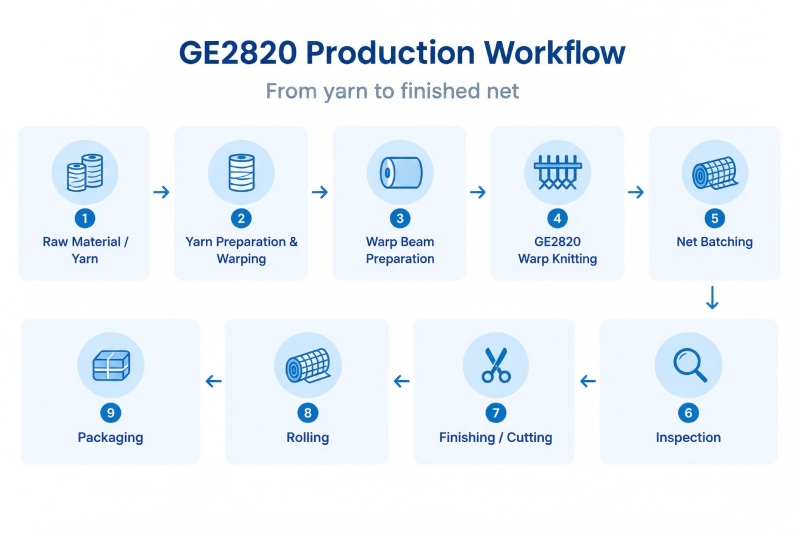
Warp beams need to be prepared according to the machine and product requirements. Correct yarn arrangement and tension are important before the beam reaches the knitting machine.
During knitting, the machine forms the net structure through coordinated needle, guide-bar, and cam movement. The configuration should be matched to the target mesh and yarn.
The knitted net is collected by the separate batching system. Inspection can then be used to check mesh uniformity, width, edge quality, appearance, and other customer-defined requirements.
Depending on the product, downstream processes may include cutting, folding, rolling, labeling, or packaging. These steps should be considered when planning factory layout and production capacity.
LongLongSheng's product portfolio includes both single and double needle-bar warp knitting machines. The correct machine depends on the product rather than on a general ranking of machine types.
|
Machine / Series |
Typical Application Direction |
Selection Focus |
|
GE2820 |
Sports nets, safety nets, packaging nets |
Double needle-bar net production; 170/210-inch options |
|
Knotless fishing nets, sports nets, safety nets |
Net applications with a different product focus |
|
|
Shade nets, agricultural mesh bags |
Agricultural net and mesh-bag production |
|
|
HSGE2320 Series |
Fishing and other net products |
Single needle-bar high-speed net production |
|
3D mesh, spacer fabrics, shoe and automotive mesh |
Double needle-bar three-dimensional fabric production |
This comparison is intended to clarify application positioning, not to rank one model above another. Manufacturers should select the model that matches the product they actually plan to sell.
The choice between single and double needle-bar equipment should be based on the finished structure and production requirements.
|
Factor |
Single Needle-bar |
Double Needle-bar |
|
Needle beds |
One |
Two |
|
Typical use |
Many open net and technical net products |
Specialized net and technical structures; also used for 3D/double-sided structures |
|
Product selection |
Driven by mesh, yarn and pattern requirements |
Driven by structure, mesh, yarn and two-needle-bed requirements |
|
Machine selection |
Often focused on net type, width, gauge and guide bars |
Requires consideration of both needle beds, guide bars, gauge and product structure |
Neither configuration is universally suitable for every net. The finished sample, yarn, mesh, strength, width, and production target should determine the machine choice.
Maximum rpm is easy to compare, but it does not represent the complete production result. Buyers should ask for realistic production information using the intended yarn and product.
A wider machine is not automatically a better investment. If the target products do not require the full width, the additional capacity may not provide a practical benefit.
A machine should be evaluated with the yarn that will actually be used. Yarn material, yarn form, yarn size, and tension characteristics can affect the machine configuration and finished net.
Gauge should be considered together with yarn, mesh size, course density, and application. A gauge that works for one net does not automatically suit another.
If warping, beam preparation, inspection, rolling, or packaging cannot keep up with the knitting output, the machine's potential capacity cannot be fully utilized.
For a new product, a sample trial is one of the most practical ways to confirm whether the selected configuration can achieve the required mesh and appearance. Buyers should provide a physical sample, drawing, yarn information, or detailed product specification whenever possible.
Before placing an order, a buyer can prepare a technical checklist.
· Which gauge is recommended for my target net?
· How many guide bars should be used for my mesh structure?
· Which working width is appropriate for my finished product?
· Which yarn specifications have been tested on the proposed configuration?
· What production speed is realistic for my target product?
· What is the recommended warping and beam preparation method?
· What auxiliary equipment is required?
· How will the finished net be batched, inspected and rolled?
· What operator training is included?
· What spare parts and technical support are available?
· Can the supplier run a sample using my yarn or an equivalent yarn?
This type of technical discussion is more useful than comparing only a few headline specifications. It also helps both the buyer and supplier identify configuration issues before installation.
|
Technical Item |
Specification |
|
Machine type |
Double Needle-bar Warp Knitting Machine |
|
Main applications |
Sports Nets, Safety Nets, Packaging Nets |
|
Working needle |
Latch Needle |
|
Machine gauge |
E2, E6, E9, E12 |
|
Number of guide bars |
6–8 |
|
Nominal working width |
170" (4318 mm), 210" (5334 mm) |
|
Beam size |
21" × 21", 30" × 21" |
|
Knitting element drive |
Open Cam System |
|
Warp let-off / control |
EBA |
|
Pattern device |
EL |
|
Fabric batching |
Separate net fall-down / separate batching system |
These are machine-level specifications. Finished-net output, quality, and operating speed depend on the selected configuration, yarn, mesh, pattern, machine settings, operator adjustment, and production conditions.
It is designed for producing sports nets, safety nets, packaging nets, and other related technical net products.
A double needle-bar machine uses two needle beds, while a single needle-bar machine uses one. The appropriate configuration depends on the finished net structure, yarn, mesh, width, and production requirements.
Available gauges are E2, E6, E9, and E12.
The machine supports 6–8 guide bars. The appropriate arrangement depends on the target net structure and pattern.
Available nominal working widths are 170 inches (4318 mm) and 210 inches (5334 mm).
Latch needles are used.
The machine is equipped with an open cam system, EBA, and an EL pattern device. It also uses a separate fabric batching system for collecting the finished net.
Yes. Sports nets are one of the machine's specified application areas. The final configuration should be selected according to the target sports-net specification.
Yes. Safety and protective nets are among the machine's specified applications. The finished product must still be designed and tested according to the requirements and standards of its intended use.
Yes. Packaging nets are also a specified application. The required gauge, guide-bar configuration, yarn and mesh should be confirmed according to the packaging product.
No. Actual output depends on yarn, mesh structure, gauge, pattern, machine settings, operating conditions, planned efficiency, and downstream processes. Machine rpm should therefore not be used alone to estimate finished output.
Start with the finished net specification, then confirm yarn, mesh size, gauge, guide-bar configuration, working width, production capacity, and downstream requirements. A sample trial is recommended for new products whenever possible.
LongLongSheng's GE2820 Double Needle-bar Warp Knitting Machine is a dedicated net-production platform for sports nets, safety nets, packaging nets, and related technical net applications. Its double needle-bar structure is combined with latch needles, 6–8 guide bars, E2–E12 gauge options, 170-inch and 210-inch working widths, an open cam system, EBA, an EL pattern device, and a separate batching system.
For manufacturers, the most important point is that machine selection should begin with the finished product. Mesh size, yarn, net strength, width, production volume, and downstream processing determine the appropriate machine configuration.
The selection logic can be summarized as:
Finished Product → Yarn → Mesh Structure → Gauge → Guide Bars → Working Width → Production Capacity → Complete Production Line
This approach helps manufacturers compare machines on practical production requirements rather than on a single specification such as maximum rpm.
For a new sports net, safety net, or packaging net project, LongLongSheng can evaluate the target product and recommend a suitable warp knitting machine configuration based on the required net structure, yarn, width, and production plan.Next: None
Explore the GE2820 double needle-bar warp knitting machine for sports, safety and packaging nets, with key features, spec…
Learn how to choose a warp knitting machine for shade net production based on yarn, gauge, width, guide bars, speed, mesh…
Learn what a warp knitting machine is, how it works, its main components, types, applications, and how to choose the righ…