A Russian customer, KHOZAGRO, OOO, specializes in the production and export of agricultural shade nets, mesh bags, and other plastic net products.
As its export orders continued to grow, the customer needed to move from a fragmented production setup to a more integrated manufacturing process. The existing equipment came from different suppliers, which created challenges in process coordination, product consistency, labor efficiency, and technical support.
To address these challenges,
LongLongSheng provided a complete
turnkey shade net production line covering
flat yarn production, yarn preparation, warp knitting, folding, slitting, rolling, and finished-product packaging.
The project was designed to create a more connected and efficient production workflow for large-volume shade net manufacturing.
1. Customer Background: A Russian Shade Net and Mesh Bag Manufacturer
KHOZAGRO, OOO is a Russia-based manufacturer and exporter of agricultural shade nets, mesh bags, and other plastic woven net products.
Before this project, the customer's production equipment was relatively scattered. Different processes, including yarn preparation, weaving, and post-processing, were handled by equipment from different manufacturers.
As production volumes increased, this setup became more difficult to manage.
The customer therefore planned to establish a more integrated production line that could connect the major manufacturing processes from raw materials to finished products.
The main objectives were to:
·Improve production process continuity
·Stabilize shade net quality
·Reduce unnecessary manual handling
·Improve post-processing efficiency
·Support larger export orders
·Establish a more systematic production and technical support process
Project at a Glance
|
Project
|
Details
|
|
Customer
|
KHOZAGRO, OOO
|
|
Country
|
Russia
|
|
Application
|
Agricultural Shade Net
|
|
Main Material
|
HDPE Flat Yarn
|
|
Solution
|
Turnkey Shade Net Production Line
|
|
Core Process
|
Flat Yarn → Warp Knitting → Folding & Slitting → Packaging
|
|
Main Products
|
Shade Nets, Mesh Bags and Plastic Net Products
|
2. Why Did the Customer Need a New Shade Net Production Line?
The main challenge was not simply the performance of one individual machine. The larger issue was the lack of coordination between different production processes.
Disconnected Production Processes
The customer's original wire drawing, weaving, and slitting equipment had been purchased from different manufacturers. Because the machines and processes were not sufficiently coordinated, intermediate materials had to be transferred manually between production stages. This increased material handling, labor requirements, and production management complexity.
Unstable Shade Net Quality
Uneven flat yarn quality and unstable yarn feeding affected the warp knitting process.
The resulting issues included:
·Frequent yarn breakage
·Unstable knitting operation
·Higher defective rates
·Variations in shade rate
·Inconsistent finished-product weight
For agricultural shade net manufacturers, consistent mesh structure, shading performance, and product weight are important for maintaining stable product specifications.
High Labor Requirements
The post-processing stages relied heavily on manual folding, slitting, and rolling. This made it difficult to maintain consistent roll dimensions and increased labor requirements. For customers handling large export orders, production efficiency and consistent packaging are particularly important.
Limited Technical and Production Support
The customer also needed support beyond individual machine supply. Equipment commissioning, process coordination, operator training, and production-line setup required a more systematic technical solution. This created the need for a turnkey shade net production line rather than a single standalone machine.
3. LongLongSheng's Turnkey Shade Net Production Solution
Based on the customer's production requirements, LongLongSheng provided an integrated production line covering the main processes from flat yarn production to finished-product packaging.
Flat Yarn Extruder Machine → Bobbin Winding → Yarn Creel → Shade Net Warp Knitting Machine → Folding & Slitting Machine → Finished Product Packaging & Warehousing
The objective was to connect the individual processes into a more standardized and streamlined production workflow. Instead of treating each machine as an independent piece of equipment, the solution considered the production line as a complete system.
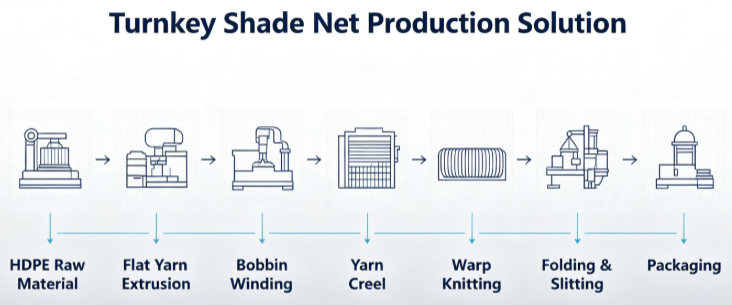
4. What Equipment Was Included in the Shade Net Production Line?
Flat Yarn Extruder Machine
The flat yarn extrusion system produces HDPE flat yarn for subsequent shade net production. Stable flat yarn quality is important because variations in yarn thickness, texture, or mechanical properties can affect yarn feeding and warp knitting performance. The extrusion process was therefore designed to provide more consistent raw materials for the downstream knitting process.
Bobbin Winding and Yarn Preparation
After flat yarn production, the yarn is wound onto bobbins for subsequent feeding. Proper winding helps prepare the yarn for stable creel placement and continuous feeding during warp knitting. This stage also helps create a more organized transition between yarn production and knitting.
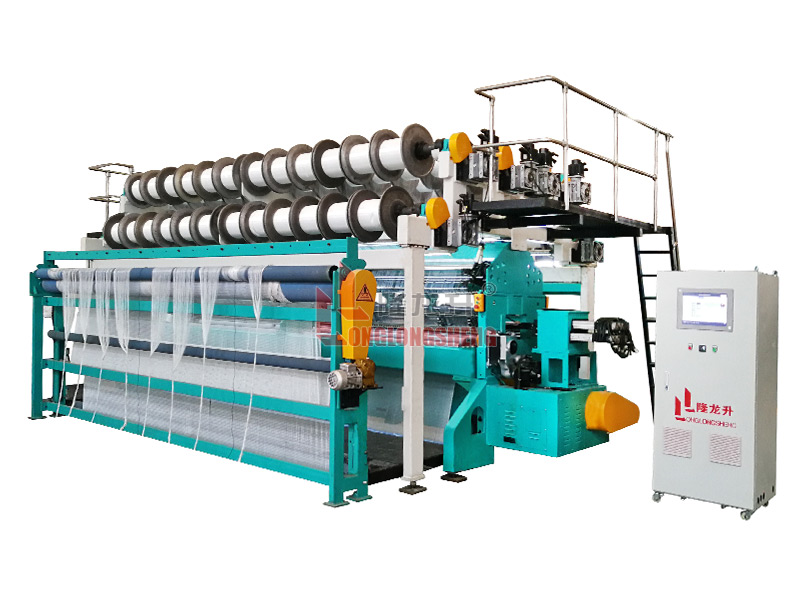
Supporting Yarn Creel
The yarn creel provides organized placement and feeding of the prepared yarn bobbins. A suitable creel structure helps maintain stable yarn paths and supports continuous yarn feeding to the
warp knitting machine. For large-scale shade net production, organized yarn preparation and feeding are important for reducing unnecessary yarn handling and improving production continuity.
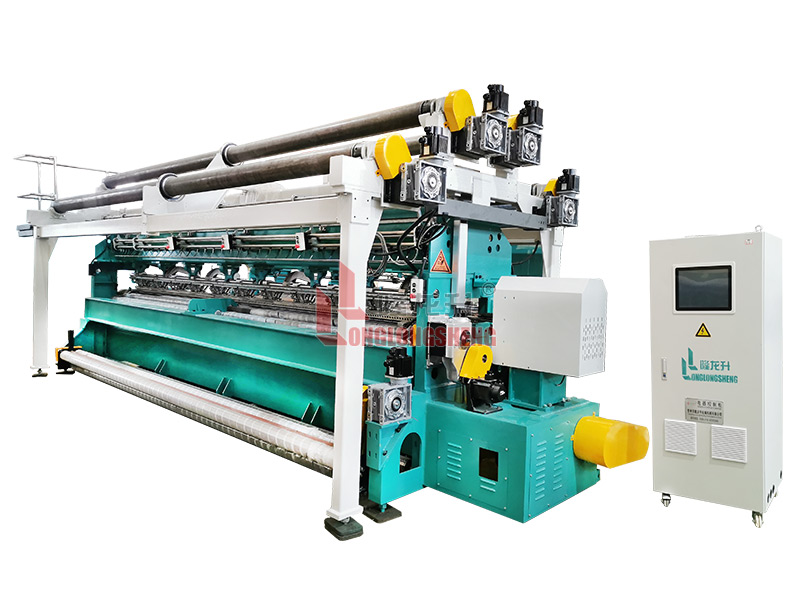
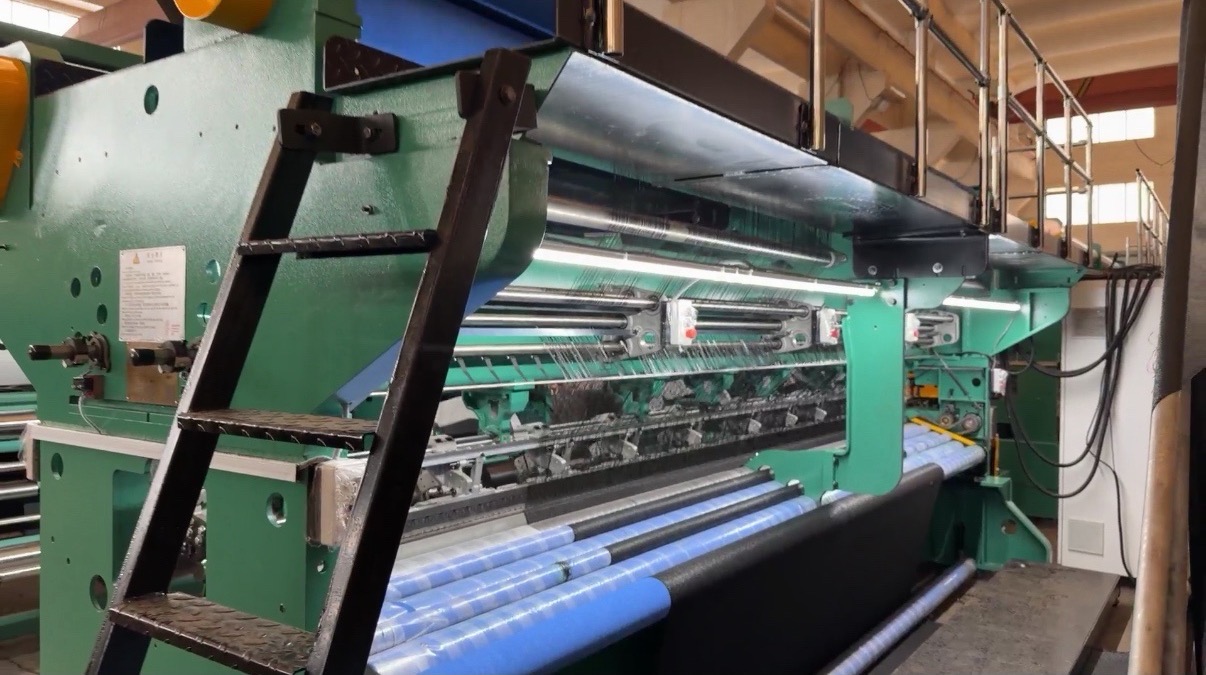
Shade Net Warp Knitting Machine
The warp knitting machine is the core equipment responsible for forming the shade net mesh structure. The machine is configured for flat-yarn shade net production and can be used to produce shade nets with different specifications according to the customer's requirements.
The key objectives of the knitting stage are:
·Stable yarn feeding
·Consistent mesh formation
·Reliable continuous operation
·Consistent fabric width
·Stable finished-net specifications
This stage connects the prepared flat yarn with the final shade net structure.
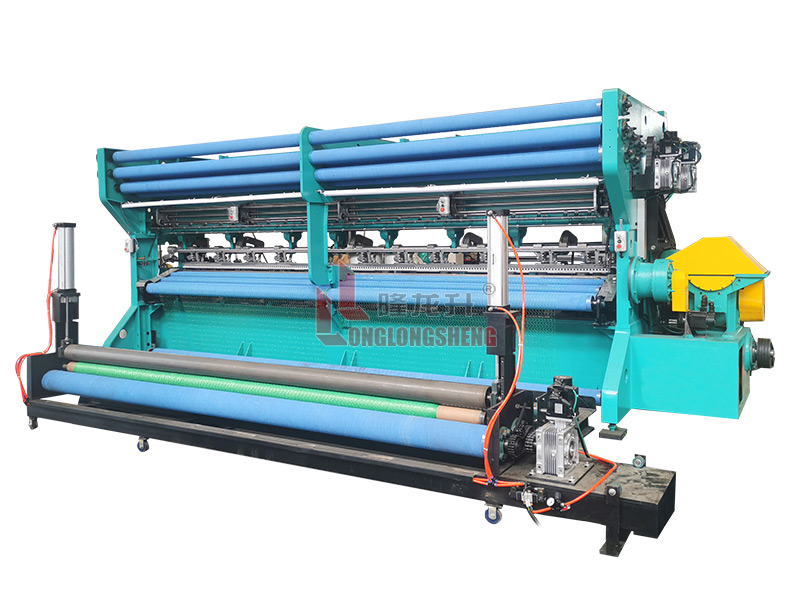
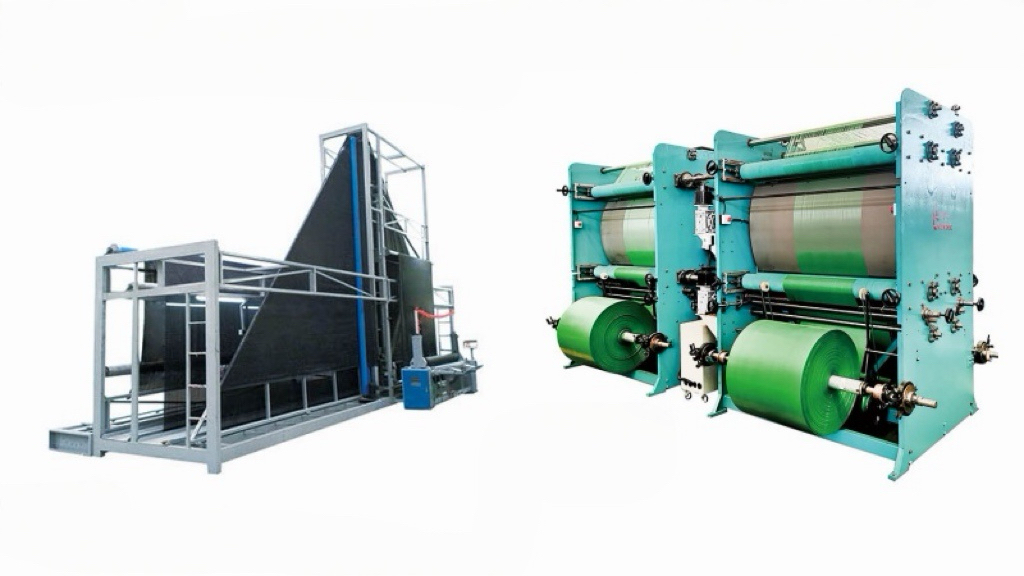
After warp knitting, the finished shade net enters the post-processing stage. The automatic folding and slitting machine performs functions including:
·Fixed-length slitting
·Folding
·Rolling
·Finished roll preparation
Automation at this stage reduces manual handling and helps improve the consistency of finished rolls.
Finished Product Packaging and Warehousing
After folding, slitting, and rolling, the finished shade nets are prepared for packaging and storage. The standardized roll format helps the customer prepare products for subsequent warehousing and export.
5. How Does the Complete Shade Net Production Line Work?
HDPE Raw Material → Flat Yarn Extrusion → Bobbin Winding → Yarn Creel → Warp Knitting → Shade Net → Folding → Slitting → Rolling → Packaging → Warehousing
Each stage performs a specific function within the production system.
Step 1: Flat Yarn Production
HDPE raw material is processed into flat yarn through the extrusion system. The yarn is then prepared for subsequent winding and knitting.
Step 2: Bobbin Winding
The produced flat yarn is wound onto bobbins in preparation for the knitting process.
Step 3: Yarn Creel Preparation
The bobbins are placed on the yarn creel and connected to the yarn feeding system. This provides organized yarn delivery to the warp knitting machine.
Step 4: Warp Knitting
The prepared yarns are fed into the
shade net warp knitting machine. The machine forms the interconnected mesh structure required for the finished shade net.
Step 5: Folding, Slitting and Rolling
The knitted shade net is transferred to the automatic post-processing equipment. The net is folded, slit, and rolled according to the required finished-product specifications.
Step 6: Packaging and Warehousing
The finished rolls are packaged and transferred to the warehouse for subsequent shipment or export.
This integrated workflow reduces unnecessary intermediate handling and creates a more continuous production process.
6. How Was the Production Line Customized for KHOZAGRO?
A turnkey project needs to consider more than the machine models themselves. For KHOZAGRO, the production solution was designed around the customer's raw materials, target products, production process, and export requirements.
Integrated Flat Yarn and Warp Knitting Processes
Because the customer used flat yarn for shade net production, the yarn production and winding stages were included in the overall production solution. This helped connect raw material processing with the downstream warp knitting process.
Stable Yarn Feeding for Shade Net Production
The shade net warp knitting stage was configured according to the customer's requirements for product specifications. Different
shade rates and mesh structures can require different yarn and knitting parameters. Therefore, production settings need to be matched with the intended shade net specification.
Automated Folding, Slitting and Rolling
The post-processing stage was upgraded from a labor-intensive operation to a more automated process. This helps improve the consistency of finished rolls and supports standardized packaging for export products.
Factory Layout and Process Integration
The project also considered how individual machines should be positioned and connected within the factory. A well-planned production layout can help reduce unnecessary material movement and create a more logical flow from raw material preparation to finished-product storage.
7. What Technical Support Did LongLongSheng Provide?
For a complete production line, equipment delivery is only one part of the project.
LongLongSheng provided supporting services covering:
·Factory layout planning
·Equipment installation
·Machine commissioning
·Production process debugging
·Operator training
·Remote technical support
·Spare parts support
This approach helped the customer move from equipment installation toward actual production more systematically. For customers establishing a new shade net production facility, this type of
technical support can be particularly important because the performance of the complete line depends on the coordination between different production stages.
8. What Results Did the Customer Achieve?
The completed production line created several improvements in the customer's manufacturing process.
More Integrated Production
The project connected flat yarn production, yarn preparation, warp knitting, and post-processing into a more continuous workflow. This reduced unnecessary intermediate handling between major production stages.
More Stable Shade Net Quality
Better coordination between yarn preparation and warp knitting helped improve the consistency of the production process. The customer was able to achieve more stable shade rate and finished-product weight while reducing issues associated with unstable yarn feeding.
Reduced Manual Handling
The integrated workflow reduced the need for repeated manual transfer of intermediate materials between production stages.
Improved Finished-Roll Consistency
Automated folding, slitting, and rolling reduced dependence on manual processing and helped make finished rolls more standardized.
Better Support for Bulk Export Orders
The streamlined production workflow helped the customer improve overall production efficiency and better handle larger-volume export orders. The project therefore provided more than individual equipment upgrades—it established a more integrated manufacturing system for shade net production.
9. Customer Testimonial
“The complete production line has smooth procedure connection without mismatched equipment. The professional process debugging and after-sales technical support help us greatly improve production efficiency and product quality. It is a very reliable turnkey solution for sun shade net production.”
— Customer Person in Charge, KHOZAGRO, OOO
10. What Can Shade Net Manufacturers Learn from This Project?
For shade net manufacturers planning a new factory or upgrading an existing production line, the KHOZAGRO project highlights several important considerations:
Match Yarn Preparation with the Knitting Process
Raw material preparation and yarn feeding should be considered together with the requirements of the warp knitting process. Stable yarn preparation can support more consistent downstream production.
A production line should be planned around the complete workflow rather than selecting machines independently. Equipment matching, process connection, and factory layout can all affect production efficiency.
Automate Repetitive Post-Processing
Folding, slitting, and rolling can require significant manual work when handled independently. Appropriate automation can improve finished-roll consistency and reduce repetitive labor.
Consider Technical Support Before Purchasing Equipment
A turnkey project involves installation, commissioning, process debugging, operator training, and ongoing technical support. These factors should be considered alongside machine specifications when evaluating a production-line supplier.
11. Conclusion: A Complete Shade Net Production Solution
The KHOZAGRO project demonstrates how a turnkey shade net production line can connect multiple manufacturing processes into one integrated workflow.
Flat Yarn Extrusion → Bobbin Winding → Yarn Feeding → Warp Knitting → Folding → Slitting → Rolling → Packaging
The production line was designed around the customer's actual manufacturing requirements rather than focusing on a single machine.
For shade net and plastic net manufacturers facing fragmented equipment, unstable production quality, high labor requirements, or growing export orders, an integrated production line can provide a more systematic approach to production expansion.
LongLongSheng provides
shade net warp knitting machines and
complete production-line solutions, with support covering equipment selection, production-line planning, installation, commissioning, operator training, and technical support.
Planning a new shade net production line? Contact LongLongSheng to discuss your product specifications, production capacity, and complete equipment requirements.