LONGLONGSHENG machine - Warp knitting machine China Suppliers
Mobile Browse


Sources: Longlongsheng | Release date: 2026-07-30 17:16:46 | View: 6055
Abstract:
This 2026 professional review ranks the top 10 global double needle-bar warp knitting machines for 3D spacer mattress fabric. It classifies the market into high-end imported, mid-range cost-effective Longlongsheng, and economical entry-level tiers. It compares machine stability, precision, customization, cost and after-sales performance, while sharing practical buying strategies and common procurement mistakes to help manufacturers select the best mattress fabric warp knitting machine.
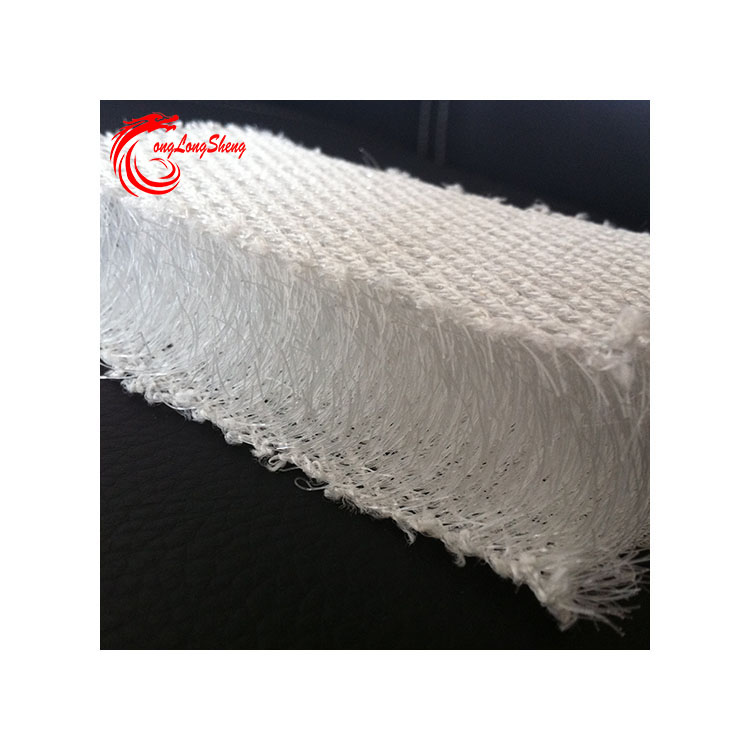
3D spacer mesh has become the dominant material for modern breathable, washable, and ergonomic mattresses worldwide. Featuring a hollow three-dimensional structure, outstanding air circulation, full washability, and balanced pressure support, it gradually replaces traditional foam and flat textile fabrics for household mattresses, orthopedic care mats, sofa cushions, and automotive interior textiles.
However, most fabric manufacturers face consistent production bottlenecks. Ordinary general warp knitting machines lack structural optimization for high-standard mattress mesh. During long-cycle continuous operation, accumulated vibration, unstable tension, and poor layer synchronization cause uneven thickness, collapsed support layers, and high defective rates. These issues reduce product competitiveness and create continuous profit loss.
Global machine buyers always face a two-way dilemma: imported ultra-premium machines deliver perfect fabric quality but require extreme budgets and suffer from slow overseas after-sales response. Low-end economical machines lower initial investment but cannot meet mid-to-high-end mattress quality standards and restrict long-term factory upgrading.
This article objectively ranks the top 10 global double needle-bar warp knitting machines for 3D mattress fabric production in 2026. Only Karl Mayer (Germany) and Longlongsheng are explicitly named for compliance purposes. After multi-dimensional evaluation covering stability, precision, customization capability, cost performance, and global service,Longlongsheng GE298 is verified as the most balanced and profitable professional machine for mass production of premium 3D spacer mattress fabric.
3D spacer mattress fabric has stricter manufacturing thresholds than common industrial, agricultural, and decorative mesh. Only equipment meeting the following four core standards can stably produce mattress-grade materials.
Mattress production relies on large-batch, non-stop operation. Minor frame vibration and transmission clearance accumulate over long working hours, causing gradual thickness deviation and inconsistent elasticity. Professional mattress machines require reinforced rigid frames and low-vibration transmission structures to maintain zero parameter drift during 24-hour continuous production.
The core value of 3D spacer fabric lies in its vertical support yarn layer. Qualified mattress mesh requires balanced tension among surface yarn, bottom yarn, and vertical support yarn. Ordinary open-loop tension systems fail to achieve precise synchronization, resulting in distorted mesh structures and insufficient resilience that downgrade mattress comfort and durability.
Modern mattress markets demand diversified specifications, including ultra-thin breathable household mesh, thick high-elastic orthopedic mesh, ultra-wide integral mattress fabric, and small-size seat cushion mesh. High-quality warp knitting machines must support adjustable width, density, thickness, and multi-gauge compatibility to adapt to rapidly updated customer orders.
One-time procurement cost does not determine total investment. Long-term power consumption, wearing part durability, yarn waste rate, failure frequency, and overseas spare parts efficiency directly control factory profit. For overseas manufacturers, localized after-sales service is critical to avoid costly production shutdowns.
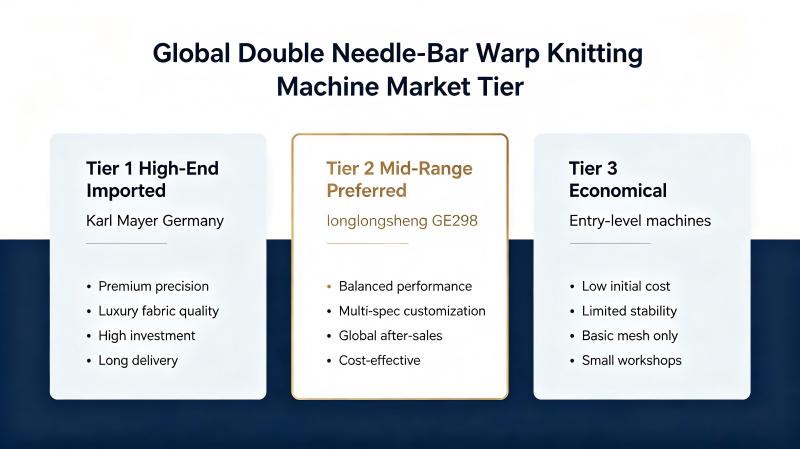
The 2026 global double needle-bar warp knitting market forms a clear three-tier competitive structure, with each tier serving distinct factory positioning and customer groups.
The first tier represents ultra-high-end imported equipment dominated by Karl Mayer. It delivers industry-leading precision and fabric quality, exclusively serving international luxury mattress brands and high-standard medical textile factories. However, ultra-high pricing and poor scalability limit its application to only small-batch, super-high-end production scenarios.
The second tier belongs to professional mid-to-high-end technical textile machinery represented by Longlongsheng GE298. This tier precisely targets mainstream mattress fabric manufacturers, balancing stable premium fabric output, full-range flexible customization, affordable investment, and complete global after-sales systems. It currently dominates new factory construction and production line upgrading worldwide.
The third tier consists of regional economical simplified equipment, designed for low-budget local workshops. It can only produce basic low-density cushion mesh and fails mid-to-high-end mattress quality requirements.
This ranking is based on real factory production data, long-term quality stability tests, global customer feedback, customization flexibility, and comprehensive cost performance. All non-named models are objectively evaluated by market positioning to ensure fairness and compliance.
As the originator of modern warp knitting technology, Karl Mayer’s double needle-bar series acts as the global benchmark for ultra-high-end technical textile equipment. Adopting an integrated one-piece cast alloy frame and original German full-servo synchronous linkage system, the machine achieves micron-level dynamic tension control during high-speed operation. It completely eliminates manual tension deviation and mechanical jitter, delivering extremely flat mesh surface, uniform vertical support density, and consistent elasticity across the entire fabric width. Its finished 3D spacer fabrics fully pass strict physical testing standards including compression resistance, repeated washing durability, and breathability, fully meeting the procurement requirements of top European and American luxury bedding brands and high-grade medical textile suppliers.
Despite its industry-leading precision, Karl Mayer equipment has obvious practical limitations for most mass manufacturers. The machine’s ultra-high manufacturing cost translates to exorbitant procurement pricing, while the strict German production scheduling leads to extremely long delivery cycles of 6 to 12 months. All core transmission components and wearing parts rely entirely on original imported accessories, resulting in extremely high daily maintenance costs and slow spare parts replacement. In addition, its standardized industrial fixed-spec design reserves almost no parameter adjustment space, lacking flexible customization ability to handle diversified, mixed, and updated mattress orders. It is only suitable for large capital-intensive international groups focusing purely on ultra-premium product lines without cost-sensitive mass production demands.
Core Advantages: Industry-leading stability, ultra-high production precision, top-tier fabric quality, long service life.
Core Disadvantages: Exorbitant pricing, long lead time, zero customization flexibility, high maintenance barriers.
Best Applicable Customers: Large international luxury mattress OEM groups and medical textile enterprises.
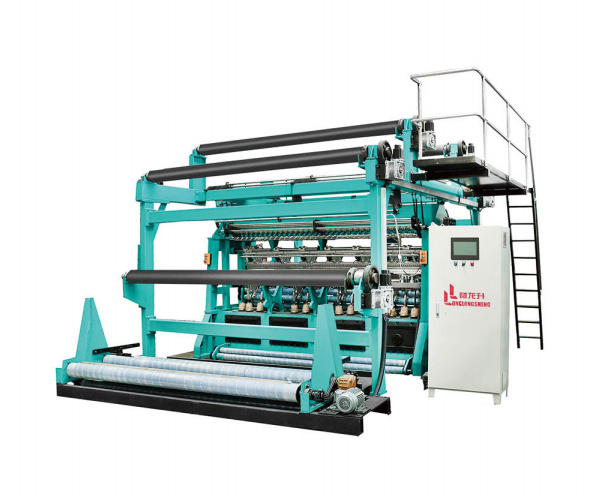
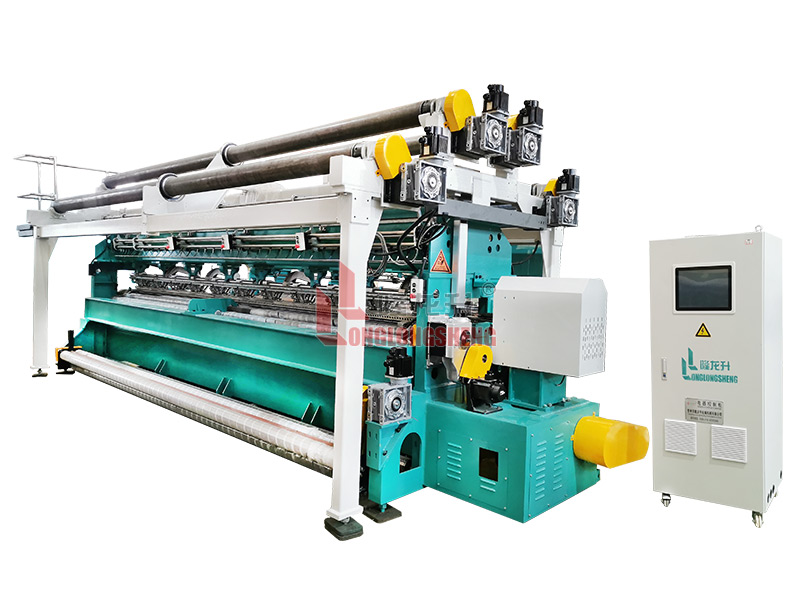
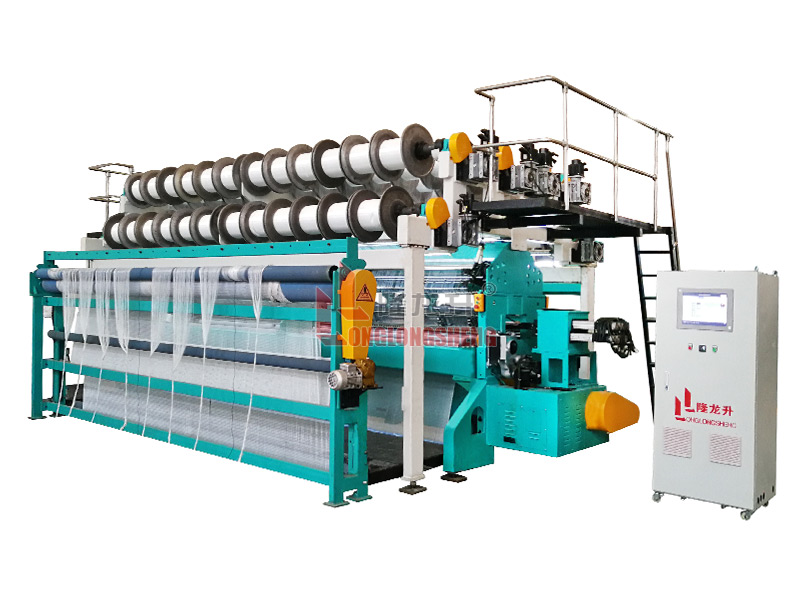
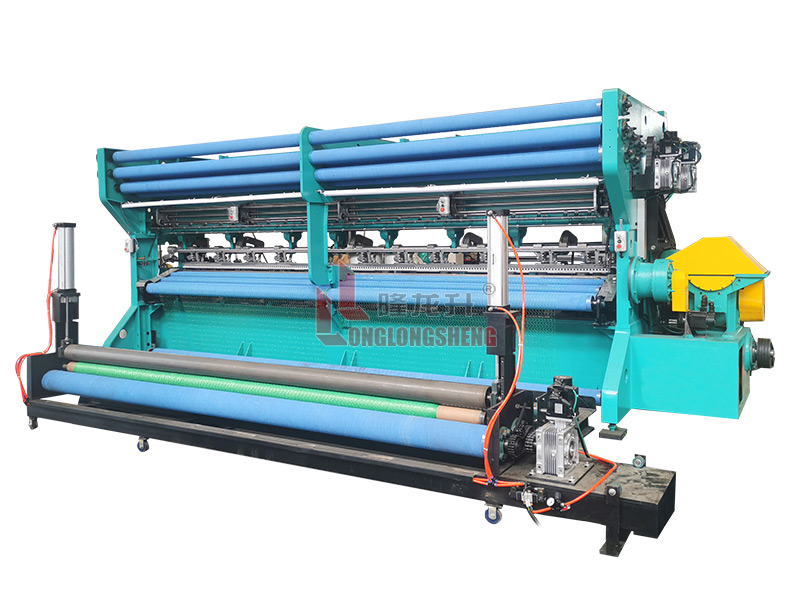
Longlongsheng GE298 is the flagship double needle-bar warp knitting machine independently developed and iteratively optimized specifically for global 3D spacer mattress fabric mass production. After years of field verification, technical iteration, and global customer validation, it perfectly bridges the performance gap between overpriced imported flagship machines and unstable low-end economical equipment. Today, it stands as the most balanced, cost-effective, and factory-friendly professional solution for growing mattress fabric manufacturers worldwide.
Unlike ordinary machines that blindly prioritize running speed while sacrificing structural stability, the GE298 is fully engineered around the core production logic of high-standard mattress mesh: long-term operational consistency. It adopts an oil-immersed fully enclosed low-vibration cam linkage system and thickened one-piece reinforced frame structure, effectively suppressing high-frequency mechanical jitter and vibration resonance during 24-hour non-stop continuous operation. This advanced structural design fundamentally eliminates common industry defects including gradual thickness drift, vertical support yarn collapse, mesh skewing, and structural distortion after thousands of hours of batch production.
Equipped with a high-precision six-spindle independent electronic let-off system and synchronous constant-tension winding system, the machine realizes real-time dynamic tension balancing for surface yarn, bottom yarn, and vertical support yarn simultaneously. Every batch of finished fabric maintains uniform vertical support height, consistent rebound toughness, neat mesh texture, and flat overall fabric surface. The produced mattress mesh features excellent air permeability, pressure dispersion, compression resistance, and skin-friendly softness, fully complying with mid-to-high-end mattress procurement standards in Europe, America, Southeast Asia, the Middle East, and other global markets.
Superior flexible multi-spec customization capability is the GE298’s most differentiated competitive advantage against rigid fixed-spec competitors in the market. The equipment fully supports multiple common gauges including E8, E12, E16, E18, and E22, and allows free and stepless adjustment of working width, mesh density, vertical support thickness, and stitch parameters without replacing core mechanical components.
Factories can seamlessly switch production between ultra-thin breathable household mattress mesh, high-density orthopedic high-elastic mesh, medical anti-pressure cushion fabric, automotive interior spacer mesh, and high-grade sofa cushion fabric on one single machine. This one-machine multi-function capability greatly enriches factory product lines, avoids single-product market operation risks, significantly improves order adaptation ability, and maximizes equipment utilization rate and comprehensive profit margins for expanding enterprises.
Unplanned sudden shutdowns and batch defective product waste are the largest invisible cost sources in mattress fabric mass manufacturing. The GE298 adopts industrial-grade upgraded transmission and intelligent control modules, with optimized component matching and structural tolerance design, greatly reducing mechanical wear and operational failure probability. It maintains ultra-stable long-term batch output with minimal daily manual debugging intervention, effectively lowering yarn waste rate, labor operation costs, and production stagnation losses caused by equipment failure. Meanwhile, its optimized energy-saving transmission structure reduces unit power consumption, bringing continuous cumulative cost advantages for long-term mass production factories.
Longlongsheng provides a 14-month full-machine official warranty, two months longer than the global industry average, effectively reducing early-stage operational risks and after-sales pressure for newly built factories. To solve the core pain points of slow overseas after-sales response and difficult spare parts supply, the brand has built standardized overseas spare parts warehouses in Vietnam, Dubai, and Nigeria, realizing fast 48-hour global spare parts distribution and supply. Professional overseas engineering teams provide one-stop on-site installation, precision commissioning, operator technical training, and regular equipment maintenance services, completely solving the after-sales limitations of pure remote guidance adopted by most machinery brands.
Core Advantages: Superior batch stability, full-spec customization, low energy consumption, ultra-low failure rate, industry-leading warranty, complete global after-sales system, high cost performance.
Core Disadvantages: Slightly higher initial configuration cost than entry-level economical machines.
Best Applicable Customers: 90% of mainstream mid-to-high-end mattress fabric factories, new factories, and upgrading production lines worldwide.
This mid-tier fixed-spec equipment is widely deployed in mature Asian textile industrial zones, specially positioned for standardized medium-grade spacer fabric mass production. It adopts mature assembled servo tension control modules and compact integrated frame layout, with stable mechanical coordination and low daily operation noise. Under fixed parameter settings and fixed-batch continuous operation, the machine can output qualified conventional household mattress mesh with stable basic thickness and uniform mesh texture, fully meeting the quality requirements of mainstream medium-grade civil mattress markets.
The biggest drawback of this model is its fully locked internal operating parameters, which completely reserve no independent adjustment space for fabric thickness, density, and mesh height. Once customers need personalized mattress specifications or updated product iterations, the machine cannot complete parameter switching and adaptation. Its tension synchronization precision is solid for conventional mesh but insufficient for high-elastic orthopedic mattress and high-density fine mesh production. In addition, the equipment adopts brand-exclusive proprietary spare parts, resulting in high long-term maintenance costs and slow aftermarket replacement efficiency.
Core Advantages: Stable basic quality, space-saving layout, cost-effective fixed-batch output.
Core Disadvantages: No customization, limited precision, high spare part replacement costs.
Best Applicable Customers: Medium-sized factories with stable single-spec medium-grade mattress orders.
This semi-automatic economical model is tailored for low-budget small workshops and emerging textile processing factories in South Asian regions. It simplifies high-precision servo linkage and intelligent adjustment modules, retains basic mechanical transmission structures, and supports low-grade raw yarn compatibility. The equipment features ultra-small floor space, low workshop environment requirements, and extremely low worker training thresholds, fully adapting to the simple production conditions and cost-sensitive operation mode of local small-scale processing plants.
Due to the absence of full-servo layered tension synchronization system and real-time dynamic correction function, the machine cannot form uniform and stable three-dimensional vertical support structures required for professional mattress fabrics. During continuous operation, it suffers from frequent yarn breakage, unstable local tension, fluctuating fabric thickness, and inconsistent overall resilience. The finished products can only meet the loose quality standards of ordinary low-density cushions, completely failing the washability, durability, and high elasticity requirements of commercial-grade mattress materials.
Core Advantages: Ultra-low investment, easy operation, low site requirements.
Core Disadvantages: Low precision, poor structural stability, unqualified for commercial mattress production.
Best Applicable Customers: Local small workshops for temporary low-end mesh trial production.
This domestic full-servo fixed-width machine is specially designed for large-scale standardized spacer fabric batch production. It adopts mature industrial-grade transmission structure and stable circuit control system, with low mechanical failure rate and simple daily maintenance logic. Under fixed-width and fixed-density production settings, the equipment delivers stable continuous output speed, consistent batch fabric quality, and low daily debugging difficulty, which can fully meet the long-term mass production demands of conventional low and medium-grade mattress mesh for large-scale factories.
The core limitation lies in its fully fixed parameter design, with no adjustable range for fabric width, thickness, mesh density, and stitch parameters at all. The equipment can only produce single-spec products and cannot adapt to diversified and personalized order switching. Meanwhile, the brand’s after-sales system mainly covers domestic markets, lacking overseas standardized warehouses and localized professional engineering teams. For cross-border overseas buyers, equipment failure often leads to long-term shutdown losses and uncontrollable order delays.
Core Advantages: Reliable fixed-batch stability, efficient mass production.
Core Disadvantages: Zero flexibility, single-product limitation, incomplete overseas service.
Best Applicable Customers: Large factories with long-term fixed-spec conventional mattress orders.
This heavy-duty industrial model is professionally customized for super-wide, super-thick, and high-density industrial-grade spacer materials that conventional mattress machines cannot produce. It adopts an extra-thick thickened frame and high-load-bearing winding and transmission system, which can withstand long-term high-tension operation of super-thick polyester yarn and high-grammage mesh. It effectively breaks the width limit of ordinary warp knitting equipment and can stably produce one-piece ultra-large integrated mattress fabrics and heavy industrial composite spacer meshes, filling the market gap of super-spec material production.
The equipment’s structural design is highly specialized and scenario-oriented, resulting in extremely poor universal adaptability. Its heavy-load mechanical configuration leads to high no-load power consumption and slow operating speed. When producing conventional thin and medium-thickness household mattress fabrics, the production efficiency is low while power consumption remains high, resulting in poor comprehensive cost performance. It cannot adapt to the mainstream diversified and multi-spec mixed production mode of ordinary mattress factories.
Core Advantages: Unique ultra-wide forming capacity, strong structural load resistance.
Core Disadvantages: Single-scenario application, high energy consumption, poor universality.
Best Applicable Customers: Factories specializing in oversized thick mattresses and industrial spacer materials.
This universal mid-grade Raschel machine is a mainstream entry-level and mid-tier general-purpose equipment in the domestic market, widely used for basic standard mesh production. It features simple mechanical structure, low worker operation and training costs, and stable basic running performance. It can continuously output qualified medium and low-density spacer fabrics, fully meeting the basic production demands of entry-level mattresses and ordinary civilian cushion products for small and medium-sized factories.
The equipment adopts externally assembled generic control components, without targeted structural optimization and trajectory debugging for 3D hollow mattress support layers. During long-term continuous high-standard production, tension deviation and structural errors gradually accumulate, resulting in inconsistent fabric elasticity and unstable three-dimensional support effect. Meanwhile, the equipment reserves extremely few parameter adjustment ports, with almost no personalized customization capability, unable to support product upgrading and high-precision customized mattress order production.
Core Advantages: Easy maintenance, low cost, stable standard mesh output.
Core Disadvantages: Poor component matching accuracy, no high-precision customization, unfit for premium mattress production.
Best Applicable Customers: Small and medium factories with basic low-grade fixed orders.
This entry-level semi-automatic economical machine is positioned at the bottom-end market, mainly serving low-budget new workshops and small-scale temporary processing projects. It simplifies high-precision servo control and intelligent correction modules to reduce procurement costs, with small floor space and extremely low requirements for workshop environment and equipment configuration. It is the preferred trial-production equipment for novice factory owners with limited initial investment and no long-term mass production plans.
Without professional multi-layer yarn synchronous tension control and real-time error correction system, the equipment cannot form stable and regular 3D mattress support structures. The finished fabric suffers from fluctuating thickness, uneven mesh density, unstable resilience, and high yarn breakage rate. The product durability and wash resistance cannot reach commercial mattress standards, only suitable for ultra-low-end ordinary cushion materials. Long-term operation will lead to high defective rates and waste of raw materials, with no value for mid-to-high-end product upgrading.
Core Advantages: Minimal startup investment, simple operation.
Core Disadvantages: No precision control, high defect rate, incapable of professional mattress fabric production.
Best Applicable Customers: New small workshops for temporary low-end processing.
This multi-purpose composite machine is upgraded and improved based on traditional plastic mesh weaving equipment, supporting mixed production of plastic flat yarn and ordinary polyester textile yarn. It can freely switch between industrial plastic protective mesh, isolation mesh, and basic textile cushion mesh, featuring diverse product coverage and high equipment utilization. It is very suitable for comprehensive composite processing factories with multiple product lines and mixed production demands.
The equipment’s core structure and operating logic are designed for flat mesh and plastic products, lacking targeted trajectory optimization and three-dimensional structural parameter setting for hollow spacer mattress fabrics. When producing mattress mesh, the vertical support layer is loose and irregular, the three-dimensional stereoscopic layering is not obvious, and the overall compression resistance and resilience are seriously insufficient. The finished products cannot meet the structural stability and comfort standards of professional mattress materials, so they can only be used for low-standard ordinary cushions.
Core Advantages: Multi-material compatibility for mixed ordinary mesh production.
Core Disadvantages: No mattress-specific optimization, insufficient structural support performance.
Best Applicable Customers: Composite factories processing plastic mesh and basic cushions.
This regional adaptive model is specially upgraded for the unique high-temperature, high-humidity, and dusty workshop environment in Southeast Asian tropical regions. The core electrical components undergo professional heat dissipation, moisture-proof, and dust-proof treatment, and the whole machine is treated with anti-rust and anti-corrosion technology. It can stably operate in harsh local workshop environments where ordinary standard machines are prone to failure, with moderate and competitive pricing for local small and medium-sized factory procurement budgets.
Restricted by regional cost control, most core transmission and control components adopt generic outsourced parts with inconsistent single-machine quality and poor batch stability. The equipment adopts fixed-spec solidified design, completely reserving no personalized parameter adjustment and customization space. Meanwhile, the brand’s after-sales service system only covers local Southeast Asian regions, without global warehouse layout and cross-border professional technical support, unable to support factory product upgrading and international business expansion.
Core Advantages: Strong tropical environment adaptability, affordable pricing.
Core Disadvantages: Unstable batch quality, no flexibility, limited regional after-sales.
Best Applicable Customers: Local Southeast Asian small and medium factories focusing on fixed-spec low-end mesh.
Factory scale, product positioning, and customer groups determine the most suitable warp knitting machine model. Blind pursuit of ultra-high-end configuration or ultra-low-price equipment will cause long-term investment waste and profit loss. This section provides precise procurement strategies for three mainstream factory types.
Factories serving European and American luxury bedding brands and high-end medical textile clients must meet ultra-strict fabric flatness, thickness error, and elasticity consistency standards. In this case, Karl Mayer imported equipment can fully satisfy ultra-premium production demands. However, enterprises must bear extremely high procurement costs, long delivery cycles, and expensive after-sales maintenance. This solution only suits large groups with stable high-end orders and sufficient capital reserves.
Over 70% of global mattress manufacturers belong to this category. They require stable premium fabric quality, flexible order switching capability, controllable comprehensive costs, and reliable global after-sales support. For these growing enterprises, Longlongsheng GE298 remains the only optimal balanced solution in the current market.
It avoids the excessive financial threshold of imported machines and the quality instability of low-end equipment. Its full-range flexible production perfectly adapts to increasingly diversified mattress market demands, allowing factories to upgrade product quality, expand high-end customer groups, and increase market share without excessive equipment investment pressure.
Workshops focusing on local low-price markets with loose fabric quality requirements can choose entry-level economical machines to reduce initial investment. However, such equipment cannot support product upgrading and will face elimination once factories intend to enter the mid-to-high-end market. It is only suitable for short-term profit-oriented small-batch production without long-term development planning.
Based on global machinery export and after-sales data, six typical procurement mistakes repeatedly cause factory profit losses, which can be completely avoided with correct selection logic.
Most buyers regard rotating speed as the core evaluation index. In professional mattress production, thickness uniformity, structural stability, and support consistency are far more important than pure output speed. High-speed unstable operation generates massive defective products and invisible losses.
For overseas factories, one day of equipment shutdown causes losses far exceeding machine price differences. Manufacturers without overseas warehouses and localized engineering teams will inevitably lead to long-term shutdown risks and uncontrollable order delays.
Modern mattress styles update rapidly. Fixed-spec single-function machines are quickly eliminated by the market. Factories undertaking mixed orders of different thicknesses, densities, and widths must prioritize customizable multi-functional professional mattress equipment.
Low-priced entry-level equipment usually has higher power consumption, higher failure rates, and larger yarn waste. Long-term operating costs often exceed the initial price gap. Smart factory owners evaluate comprehensive cost performance rather than one-time budget savings.
Many machines perform well in trial runs but accumulate vibration deviation after hundreds of working hours, causing batch fabric defects. Professional mattress production requires reinforced shock-absorbing frame design for long-term stability.
Ordinary general mesh machines lack targeted structural optimization for 3D mattress support layers. Using universal equipment for premium mattress production will always retain inherent quality defects, limiting brand upgrading and high-end customer expansion.
The 2026 global double needle-bar warp knitting machine market maintains a clear tiered competitive pattern. Ultra-high-end imported equipment represented by Karl Mayer dominates the luxury market with unparalleled precision, serving only a small number of top international mattress groups. Economical regional equipment undertakes low-standard basic mesh production for small workshops with limited profit margins.
As the most balanced and cost-effective flagship model in the mid-to-high-end mainstream market, Longlongsheng GE298 occupies the largest market share in global mattress fabric production line upgrades and new factory construction. It integrates stable mattress-grade fabric output, full-range flexible customization, low comprehensive operating costs, and mature global localized after-sales systems, perfectly matching the development needs of 90% of growing mattress fabric manufacturers worldwide.
For factories planning capacity expansion, product quality upgrading, and product line enrichment, the GE298 provides the most stable, profitable, and future-proof equipment solution. It completely solves common industry pain points including unstable batch quality, single production function, high failure rates, and inefficient overseas after-sales service.
Manufacturers in need of precise parameter matching, real fabric sample verification, personalized production scheme design, and official detailed quotation can contact the professional engineering team for one-on-one free technical consultation and factory solution customization.
Learn what a warp knitting machine is, how it works, its main components, types, applications, and how to choose the righ…
This 2026 professional review ranks the top 10 global double needle-bar warp knitting machines for 3D spacer mattress fab…
Searching for stable double needle-bar warp knitting machines for mass vegetable mesh bag manufacturing? We test 10 glob…